I Know Where My Container Is: Real-Time Tracking Arrives in Maritime Shipping
 Dennis Knake
Posted On 2nd March 2026
Dennis Knake
Posted On 2nd March 2026
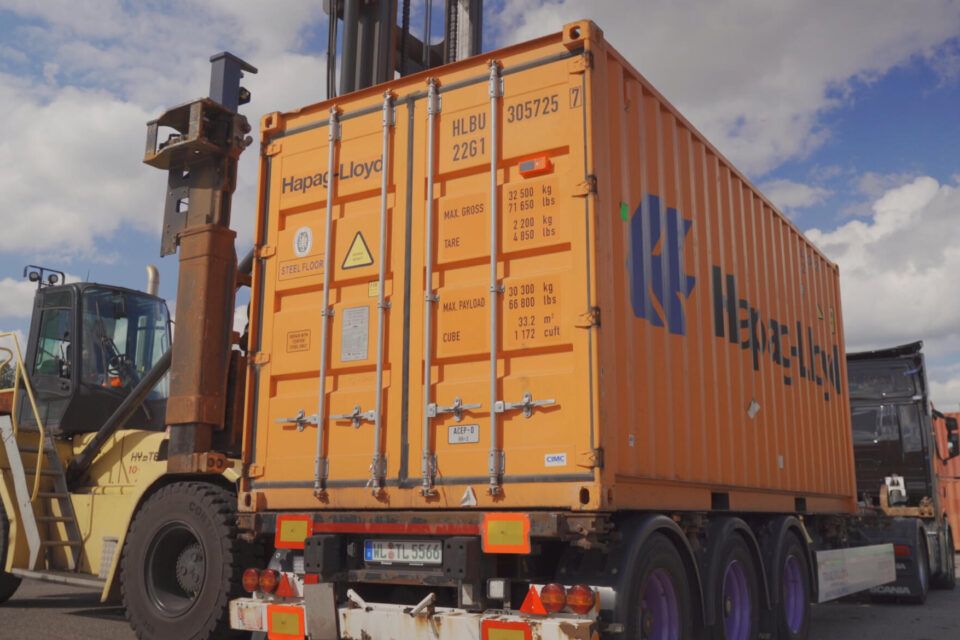
“Your order will arrive today between 2 and 6 PM. Click here for live parcel tracking.” Retailers keep customers up to the minute on items ordered online yesterday: when the goods left the warehouse, when they were handed over to the parcel carrier, and where the delivery van is currently located. What has long been common in parcel shipping is a novelty in freight transport by shipping container.
Hapag-Lloyd, headquartered in Hamburg, is one of the world’s leading liner shipping companies in container transport and is listed on the Frankfurt Stock Exchange. The company operates more than 300 container ships with a total capacity of around two million TEU — with TEU (“Twenty-foot Equivalent Unit”) being the internationally used standard unit for container capacity and corresponding to one 20-foot container.
Last year, Hapag-Lloyd transported 12.5 million TEU and generated revenues in the double-digit billions.
Digitalization as a Strategic Competitive Advantage
In a market in which around 90 percent of global trade is carried by sea — and which is shaped by geopolitical tensions, supply chain disruptions, and rising sustainability requirements — Hapag-Lloyd is increasingly focusing on digitalization, data-driven services, and efficiency improvements.
The expansion of the smart container fleet is part of a strategy through which the company aims to differentiate itself technologically and at the same time become more resilient to global disruptions.
It began with refrigerated containers, which were equipped with sensors to monitor cold chains. But there was more to do.
In recent years, the company additionally equipped around two million so-called dry containers with modern tracking sensors. A dry container is the standardized, fully enclosed shipping container without refrigeration or special equipment that is used to transport dry goods such as pallets, cartons, or machinery in global container traffic.
The Real Gap: Inland Transport
“When tracking the location of our containers, we’re not concerned with their current position on the oceans. We already know that from our vessel data,” says Karsten Schmidt, Director & Product Owner Live Position at Hapag-Lloyd. “The major gaps arise whenever containers are moving to or from the customer on land.”
Using satellite-based positioning systems such as GPS, Galileo, or GLONASS, the trackers continuously determine their current position. The data is then transmitted via mobile standards such as LTE with global roaming — supplemented by satellite communication where necessary — to the shipping company’s cloud systems.
Among others, tracking devices from the IoT specialists Orbcomm and Nexxiot are used, which also integrate sensors for temperature and motion data and rely on energy-efficient, partly solar-assisted power supply. The container thus evolves from a passive transport unit into an active data node in a global logistics network.
“When tracking the location of our containers, we’re not concerned with their current position on the oceans. The major gaps arise whenever containers are moving to or from the customer on land.”
Hapag-Lloyd Live Position: The Shipping Industry’s First ETA System
Hapag-Lloyd calls its system “Live Position” and provides location data to customers either via its own website or as an API for integration into their own systems.
Other major shipping lines as well as specialized visibility platforms now also offer solutions for container tracking. However, these often rely on aggregated status messages from port and vessel systems or on selectively equipped containers, for example in the refrigerated segment.
With the near fleet-wide IoT deployment across its standard containers, Hapag-Lloyd is pursuing a comparatively comprehensive approach that treats tracking not merely as an add-on service, but as an integral part of operational infrastructure.
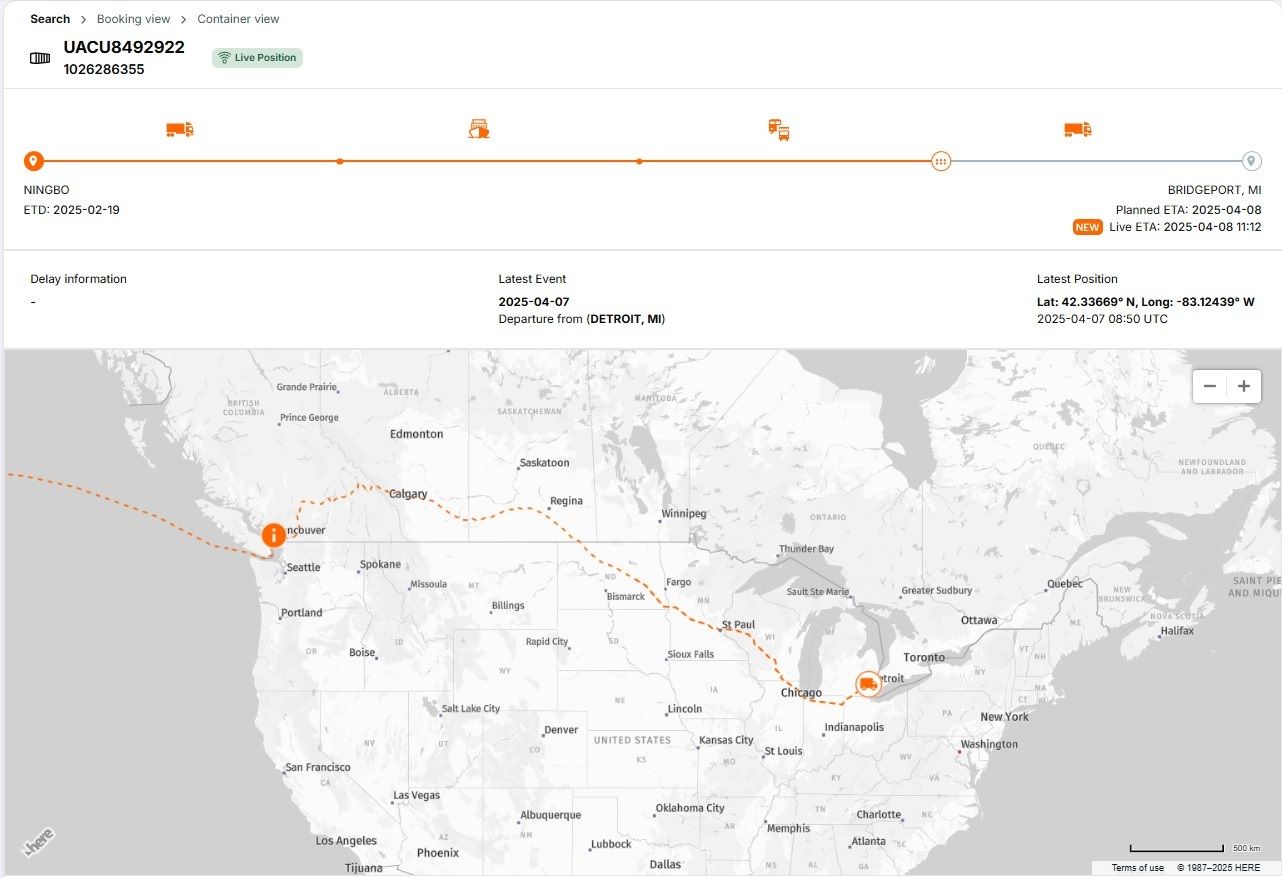
Via the Live Position platform, customers can track their containers precisely and determine the estimated arrival time. Screenshot: Hapag-Lloyd
With the new container tracking, the company now knows exactly and at all times where each individual container is located. At this scale, the project currently ranks among the most ambitious digitalization initiatives in global container shipping.
By integrating traffic data, customers can receive quite accurate arrival times, so-called “ETA” (Estimated Time of Arrival), predictions. “With our new system, we can predict arrival times 77 percent more accurately than was previously possible,” Schmidt adds.
This so-called Live ETA function is described as the shipping industry’s first dynamic system for calculating the estimated time of arrival, adjusting in real time based on actual movement and location data.
“We can make the containers visible for our customers through various data points — including the purchase order of the loaded goods,” Schmidt continues.
In addition, smart containers enable more efficient planning of transport and repositioning processes. Empty runs are among the biggest cost and efficiency drivers in logistics. Once a container has been unloaded at the customer’s site, real-time tracking allows it to be assigned in a targeted way and close to its location to a follow-up job. This reduces unnecessary transport distances, lowers costs, and helps reduce emissions.
“With our new system, we can predict arrival times 77 percent more accurately.”
Integration into Industry Systems
A first partner is WiseTech Global, an Australian software company headquartered in Sydney, which supports freight forwarders, logistics service providers, and customs agents worldwide with its cloud-based platform CargoWise in the digital handling of transport, customs, and supply chain processes.
“This partnership represents an important step toward a more transparent, resilient and digitally enabled global supply chain,” says Schmidt, who also mentions further planned cooperations in his conversation with WeSpeakIoT. The company is currently working to make the container data available in the future via systems such as SAP as well.
At present, direct customers or the freight forwarders themselves benefit most from the live tracking data of the smart container system. “Freight forwarders primarily use live tracking internally for their own business processes. They are still hesitant to make this data accessible to their end customers,” says Schmidt, adding: “With our direct customers, however, we have had very positive experiences, as we can now present the supply chain much more transparently.”
So there will still be some persuasion needed to convince the many freight forwarders to make Hapag-Lloyd’s Live Position available to their end customers.
With Live Position, the container becomes a digital data source rather than a passive transport unit. For shipping lines, this opens up new business models; for freight forwarders, greater transparency — and for shippers, a level of predictability in global trade that has so far been unusual.
Real-time tracking in container shipping is not yet a given. The technical infrastructure is in place, but broad adoption across the entire supply chain is still developing. The crucial factor will be how consistently shipping lines, freight forwarders, and shippers integrate the new data into their processes — and whether this ultimately leads to new standards.
One thing is clear: the transparency that consumers have long expected in e-commerce is now reaching global maritime transport.
User Review
( votes)