
$8 Billion for Spectrum: What the Rocket Lab-Iridium Merger Means for Satellite IoT
 Dennis Knake
Posted On 1st July 2026
Dennis Knake
Posted On 1st July 2026
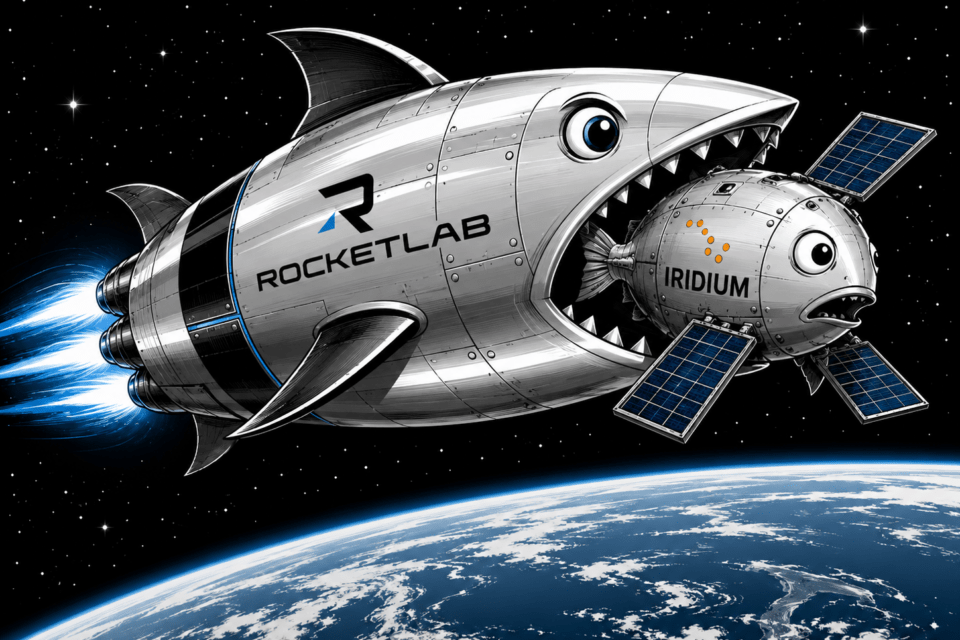
Rocket Lab is acquiring satellite operator Iridium for roughly $8 billion, transforming from a pure launch provider into a vertically integrated space company with its own global IoT network. For logistics, shipping, and industry, this shifts the balance of power in the satellite IoT market, because launch, satellite manufacturing, and network operations now sit under one roof for the first time.
- Rocket Lab is acquiring Iridium for roughly $8 billion in a cash-and-stock transaction, becoming the first publicly traded, fully vertically integrated space company.
- With 2.0 million satellite IoT subscribers, Iridium is the global market leader and, since 2018/2020, the only provider alongside Inmarsat certified for GMDSS, the mandatory maritime distress communication system.
- The deal is part of a broader consolidation wave: following Amazon’s acquisition of Globalstar and SpaceX’s purchase of EchoStar spectrum, scarce satellite spectrum is emerging as the real contested resource in orbit.
What’s in the Rocket Lab-Iridium Deal?
Rocket Lab and Iridium signed a definitive merger agreement on June 29, 2026. Iridium shareholders will receive a cash payment of $27 per share plus Rocket Lab stock under an exchange ratio tied to Rocket Lab’s own share price within a $67.50 to $112.50 collar — together worth $54 per share and an enterprise value of roughly $8.0 billion, a premium of around 24 percent over Iridium’s prior closing price. Rocket Lab is financing the cash portion in part through a committed $3.6 billion bridge facility from Deutsche Bank and Wells Fargo, supplemented by additional debt and equity sources.
The timeline is tight but not short-term: closing is expected by mid-2027, with a contractual outside date of June 28, 2027, extendable to December 2027. Conditions include Iridium shareholder approval, antitrust clearance under the Hart-Scott-Rodino process — a US pre-merger review for competitive harm in large transactions — FCC approval for the transfer of Iridium’s spectrum licenses, and additional foreign regulatory approvals. Should Iridium terminate the agreement in favor of a superior proposal, a termination fee of $223.62 million becomes payable.
Financially, Iridium brings a profitable but slow-growing business to the table: in 2025, the company generated $871.7 million in revenue and $495 million in operating earnings before interest, taxes, depreciation and amortization (which Iridium itself calls OEBITDA), a 57 percent margin, with around 2.55 million customers worldwide. The company operates a network of roughly 80 low-Earth-orbit satellites, 66 of which are active, launched between 2017 and 2019.
Why Is This Acquisition Happening Now?
The deal doesn’t stand alone. It follows Amazon’s roughly $11.6 billion acquisition of Iridium competitor Globalstar by ten weeks, and sits alongside SpaceX’s roughly $17 billion purchase of EchoStar spectrum licenses and SES’s $3.1 billion acquisition of Intelsat as part of a broader consolidation wave. Companies that combine launch, satellite manufacturing, and network operations under one roof, as SpaceX has done, can expand their constellations at internal rather than market prices — a cost advantage that single-layer providers can barely match. Rocket Lab is applying that same logic with Iridium, at a smaller but coherent scale.
At the center of all these deals lies the same resource: radio spectrum, the internationally and nationally allocated frequency bands through which satellites communicate with end devices, and which are only released in very limited quantities worldwide. Rocket Lab founder Peter Beck made exactly that argument, calling spectrum scarce and practically impossible to obtain anew in a social media post, and the market reacted accordingly — Iridium shares jumped roughly 25 percent on announcement day, with Rocket Lab shares up about 18 percent.
What Does the Deal Mean for Satellite IoT in Logistics and Shipping?
Two facts deserve particular attention here. First: the IMO recognized Iridium’s network as a GMDSS provider in May 2018, the Global Maritime Distress and Safety System; in January 2020, Iridium received formal operating authorization from the relevant oversight body, IMSO, and was cleared to launch the service. That makes Iridium the first alternative to Inmarsat, which had held that role exclusively since 1999. Under the SOLAS convention (Safety of Life at Sea), GMDSS equipment is mandatory for cargo ships of 300 gross tons and above and for passenger vessels on international voyages — effectively the entire global merchant fleet. Iridium’s low-Earth orbit (LEO) constellation also covers the polar regions, where geostationary systems like Inmarsat reach their limits. For shipping, Iridium isn’t just one tracking provider among many — it’s mandatory safety infrastructure.
Second: Iridium isn’t a follower in the satellite IoT market, it’s the leader. According to the latest research from IoT market analyst Berg Insight, the global satellite IoT subscriber base grew to over 5.8 million in 2024 and is expected to reach 32.5 million by 2029, an annual growth rate of just over 41 percent. Iridium leads the field with 2.0 million subscribers and 10 percent year-over-year growth, ahead of Orbcomm (742,000) and Globalstar (roughly 510,000).
In practice, this shows up according to Iridium’s own statements in logistics, among other areas: the company cites partners such as Geoforce, which offers tracking hardware for high-value cargo and unpowered trailers. Such figures come from the vendor itself and aren’t independently verified case studies, but they indicate the direction. Container shipping lines, too, are increasingly equipping fleets with IoT trackers that combine satellite positioning and cellular roaming, supplemented as needed by additional satellite communication — a model a financially stronger Iridium could benefit from, though that doesn’t establish which specific satellite provider sits behind any given system. Technically, the difference from Starlink remains decisive: while Starlink’s Ka- and Ku-band frequencies deliver high bandwidth via comparatively large, directional antennas, Iridium’s L-band, in the 1,616 to 1,626.5 MHz range, reliably penetrates clouds and foliage and works with small, low-power terminals — suited for shipping containers, mobile machinery, or sensor nodes with limited power budgets.
Does Iridium Stay Reliable for Customers, or Are There Integration Risks?
Rocket Lab’s and Iridium’s PR narrative is unambiguously upbeat. A sober assessment, however, needs to weigh two counterpoints.
First, the purchase price isn’t cheap by analyst standards. One assessment puts the transaction at roughly 16 times Iridium’s operating EBITDA, while the company has guided to only flat-to-2-percent service revenue growth for 2026 — not a growth rate that obviously justifies that multiple. William Blair analyst Louie DiPalma downgraded Iridium following the deal announcement, though he also pointed to value beyond spectrum, including Iridium’s PNT business (Position, Navigation, Timing, an alternative to GPS), its Aireon flight-tracking service, and several defense contracts.
Second, the competitive pressure from Starlink is real, even if both companies publicly downplay it. Iridium CFO Vincent O’Neill acknowledged shortly before the deal that Starlink will encroach on limited areas of Iridium’s business going forward, though only after several more years of expansion. Iridium CEO Matt Desch, for his part, positions Iridium’s own non-terrestrial network (NTN) service for direct-to-device (D2D) applications — the direct connection of mobile phones to satellites without a separate terminal — as complementary to SpaceX, Amazon, and AST SpaceMobile rather than a head-on competitor.
For practitioners in logistics and shipping, this means in concrete terms: existing Iridium contracts and certifications won’t change in the short term as a result of the deal. In the medium term, much depends on whether FCC approval is granted as expected, and whether Rocket Lab actually invests in the next expansion of the Iridium constellation after closing — whose design life Iridium already extended to at least 2035 in 2024.
Conclusion
The real value of this deal lies not in the roughly 80 satellites Rocket Lab is acquiring, but in the L-band spectrum those satellites use, and in the market leadership Iridium already holds in satellite IoT. For practitioners in logistics, shipping, and industry, little changes operationally for now — contracts, certifications, and hardware integrations continue unchanged. Still, it’s worth watching: the FCC’s decision on the spectrum transfer will become the real litmus test in the coming months for whether this announced merger actually produces a new, financially capable rival to Starlink — or whether integrating two very different corporate cultures becomes the real obstacle.
Rocket Lab is paying a cash amount of $27 per Iridium share plus Rocket Lab stock, together worth $54 per share and an enterprise value of roughly $8.0 billion. Closing is expected by mid-2027 and is subject to shareholder and antitrust approval as well as clearance from the US Federal Communications Commission (FCC).
Nothing in the short term: existing contracts, GMDSS certifications, and hardware integrations remain unchanged until the acquisition closes in mid-2027. In the medium term, a financially stronger, vertically integrated Iridium could accelerate the expansion of its IoT and safety services, provided Rocket Lab actually invests in the constellation after closing.
Radio spectrum refers to the government-allocated frequency bands through which satellites communicate with end devices — it is scarce worldwide and difficult to reallocate. Iridium’s L-band frequencies, in the 1,616 to 1,626.5 MHz range, also reliably penetrate clouds and foliage and support small, low-power terminals, which is why buyers like Amazon, SpaceX, and now Rocket Lab have paid billions in recent months for companies with existing licenses.
Yes. The IMO recognized Iridium as a GMDSS provider in 2018, and since January 2020 the service has been formally authorized and operational — covering the world’s emergency communication system at sea. Under the SOLAS convention, this equipment is mandatory for cargo ships of 300 gross tons and above and for passenger vessels, making Iridium effectively part of the safety infrastructure of the entire global merchant fleet.
Closing is expected by mid-2027. The contractual outside date is June 28, 2027, extendable to December 2027 if needed, for instance if antitrust or FCC review takes longer than planned.
Iridium uses L-band spectrum for compact, low-power terminals with global coverage including the polar regions, while Starlink operates in the higher-bandwidth Ka- and Ku-bands with larger, directional antennas. For classic asset-tracking and safety applications relying on small devices, Iridium’s approach generally remains the better technical fit, even though Iridium executives themselves expect growing competition from Starlink’s direct-to-device services.

You may also like