

Europe is emerging as an important hub for satellite-based IoT communication. In particular, numerous operators and technology providers across the continent are active in the field of Non-Terrestrial Networks (NTN) and direct-to-device (D2D) approaches. A large share of the currently known 5G-NTN-LEO satellite initiatives originates in Europe.
In addition to 3GPP-standardized 5G-NTN approaches, alternative methods for narrowband satellite-based IoT communication are also gaining importance. These include LR-FHSS (Long Range – Frequency Hopping Spread Spectrum) from Semtech, among others. European start-ups such as Fossa Systems (Spain), Lacuna Space (United Kingdom) and Plan-S (Turkey) are among the players that use or are testing LR-FHSS for satellite-based IoT applications.
Plan-S is pursuing a comparatively unusual concept. From 2026, compact LEO satellites are planned that are intended to support both 3GPP-NTN and LR-FHSS. The goal is to combine different radio technologies within a single satellite platform and thus cover different use cases.
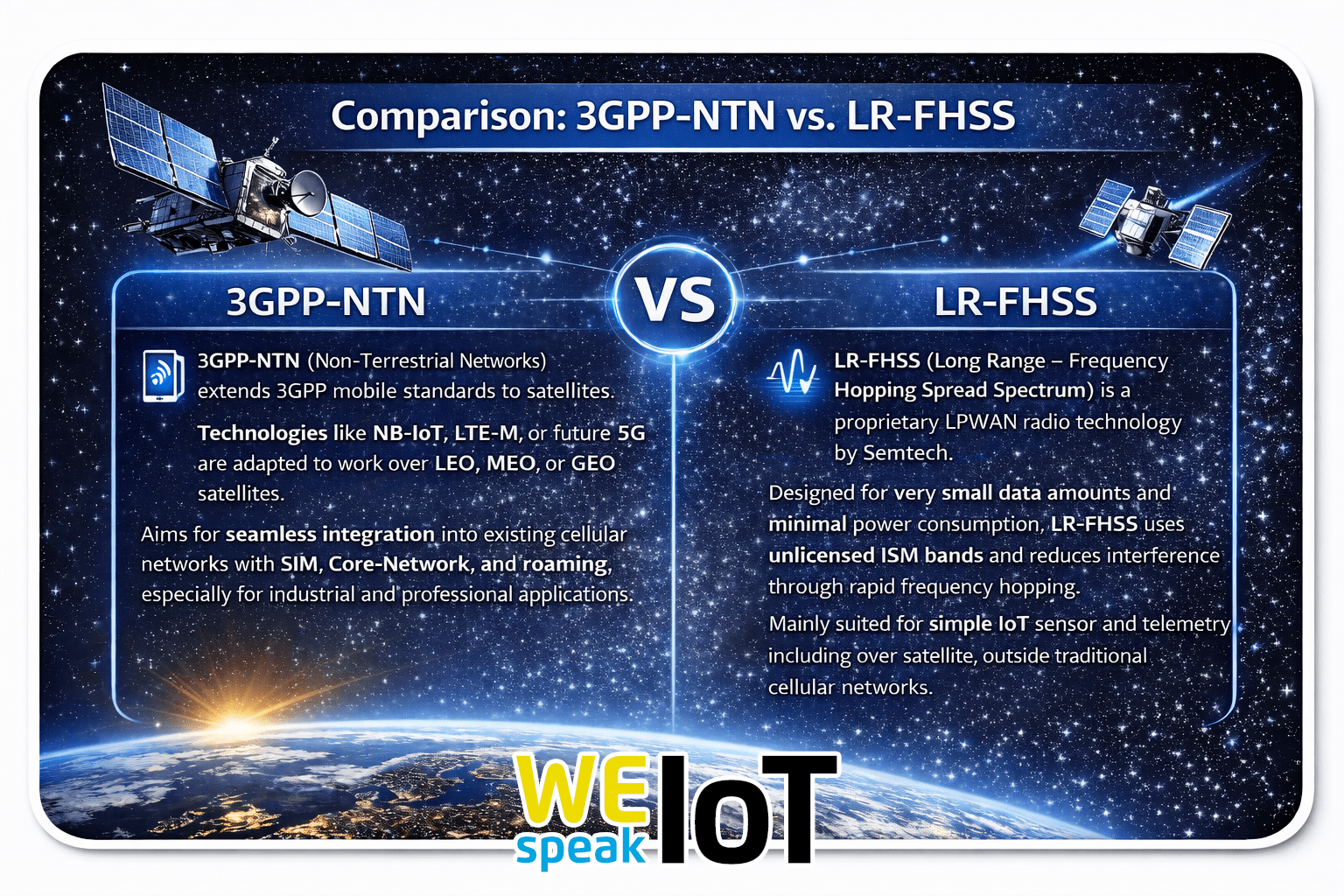
At present, both 5G-NTN-LEO services and LR-FHSS-based satellite offerings are still in the development or testing phase. Commercial services with broad, nationwide availability have not yet been established. Accordingly, many activities are focused on pilot projects, evaluation kits and early field tests.
In parallel, antenna and end-device concepts for use in NTN scenarios are being developed. A technical focus is on multiband antennas designed to cover multiple cellular and satellite standards. Such antenna concepts can reduce space requirements and costs and make integration into compact IoT devices easier.
For development and testing purposes, open hardware and software platforms are also emerging, based on common module formats such as M.2 or Feather. Some projects use open-source tools for schematic and layout design as well as open protocol stacks. The aim is to simplify entry into 5G-NTN and LR-FHSS testing and to enable transfer into proprietary prototypes.
A key differentiator between the technologies is energy consumption. According to manufacturer information, LR-FHSS requires less energy than 5G-NTN, while module sizes are in a similar range. Which technology is better suited for a specific use case depends, among other factors, on data rate, latency, power supply and global availability.
From 2026 onward, it will become clear to what extent combined satellite concepts and parallel radio technologies can succeed in the market. Europe will remain an important experimentation and development space for satellite-based IoT communication.
As of now, Antennity and Embever are offering the Antennity NTN Evaluation Kit. It includes a radio module, integrated loop antennas, open-source code for a CoAP DTLS 1.2 CID client and server, as well as code for testing sensors and network parameters. A ThingsBoard-based dashboard and satellite connectivity round out the package. The customer powers on the kit and immediately gets a comprehensive overview of terrestrial and orbital networks.

You may also like