

The demands on the Industrial Internet of Things (IIoT) are no longer growing linearly — they are growing exponentially. Where simple sensors once sporadically transmitted small data packets, modern industrial scenarios now demand real-time data processing, massive device density, and absolute fault tolerance.
- DECT NR+ (ETSI TS 103 636) is the industrial evolution of DECT and was recognized by the ITU-R as IMT-2020/5G in 2020 — with a focus on scalable, reliable IIoT communication.
- Compared to LoRaWAN, DECT NR+ primarily targets applications requiring higher data rates (Mbit range) and low latency (under optimal conditions, typically single-hop) — e.g., OTA updates, detailed telemetry, and time-critical processes.
- Mesh topology and short radio links (typically ~300 m LoS or 50–100 m indoors per node) enable robust, expandable networks; for ultra-low-power sensing with multi-year battery life, LoRaWAN often remains the more suitable choice.
In this new reality, established technologies such as LoRaWAN (Long Range Wide Area Network) are hitting their design-imposed limits. Anyone seeking to digitize complex process chains needs a more robust infrastructure for information. This is where DECT NR+ (New Radio Plus) enters the picture — the first non-cellular 5G standard that fundamentally reshapes the playing field for mass IIoT. The name is no coincidence: DECT (Digital Enhanced Cordless Telecommunications) was originally the proven standard for cordless telephones — NR+ is its consistent industrial evolution, standardized by the European standards body ETSI (specification TS 103 636) and recognized by the ITU-R as a full 5G/IMT-2020 standard in 2020.
The Performance Leap: Data Rates and Latency in Focus
The most significant difference between classic LPWAN (Low Power Wide Area Network) and DECT NR+ lies in connection performance. While LoRaWAN is primarily designed for energy efficiency at very low data rates (up to a maximum of 50 kbit/s), DECT NR+ offers bandwidth in the Mbit range. This difference is more than a technical curiosity — it determines the market viability of applications:
- Complex Over-the-Air Updates (OTA): In a world where Software-Defined-Everything is becoming the norm, hundreds of devices must be updatable simultaneously and quickly. DECT NR+ makes this possible where LPWAN reaches its design limitations.
- Detailed Telemetry: Modern industrial sensors today deliver high-resolution time series data required for predictive maintenance or real-time quality control.
- Safety-Relevant Video Surveillance: Integrating image data to secure industrial premises requires continuous and stable data transmission.
Even more critical is latency. In automated environments, milliseconds determine efficiency and safety. DECT NR+ enables latency in the single-digit millisecond range through its technological architecture (under optimal conditions, typically in single-hop operation). This brings applications within reach that previously required costly cabling or complex cellular solutions. An important note for planners: DECT NR+ is not primarily designed for ultra-low power like LoRaWAN. The standard relies on a TDMA/FDMA-based duty-cycle operation, which offers a manageable energy budget for industrial applications with mains power or high-capacity batteries — but for battery-powered sensors with runtime requirements of several years, LoRaWAN remains the better choice.
The Mesh Architecture: Decentralized Intelligence Instead of Central Weak Points
One of the greatest strategic advantages of DECT NR+ is its mesh network structure. Traditional cellular networks depend on central base stations — if a base station fails, communication across the entire cell collapses.
DECT NR+ establishes a decentralized paradigm:
- Self-Organization: Each device simultaneously acts as a transmitter, receiver, and relay node.
- Dynamic Path Finding: Data packets navigate intelligently through the network. If a path is blocked, the system automatically finds an alternative route.
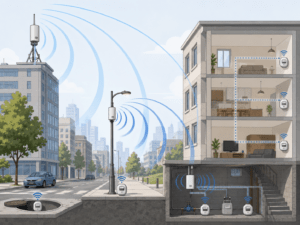
- Plug-and-Play Scaling: New devices automatically integrate into the existing topology. This not only increases capacity but also extends range in hard-to-reach areas such as basements or shielded production halls.
For reference: a single DECT NR+ node typically achieves approximately 300 meters in open field (line-of-sight), and 50 to 100 meters indoors depending on building materials — values that can be extended as needed through mesh topology.
This robustness makes mesh networks the ideal framework for critical IIoT infrastructures where downtime immediately generates high costs.
Global Scalability Through the 1.9 GHz Band
For companies operating globally, technological fragmentation is often a nightmare. LoRaWAN uses different frequency bands worldwide (868 MHz in Europe, 915 MHz in the US, various bands in Asia). The result: hardware development and logistics become complex and expensive.
DECT NR+ primarily uses the 1.9 GHz band, which is available license-free in many markets, particularly in Europe. This eliminates the need for country- or continent-specific hardware variants. One product, one radio technology, worldwide deployment — that is the efficiency the IIoT needs to move from costly pilot projects to global scaling.
Sovereignty Through Technological Freedom of Choice
LoRaWAN will continue to have its place wherever maximum energy efficiency with minimal data volume is required. But wherever robustness, real-time capability, and scalability are the conditions for commercial success, DECT NR+ is the more powerful alternative.
Industry does not need more “island solutions.” It needs a reliable communication architecture that grows with its requirements. DECT NR+ delivers exactly this framework for the connected world of tomorrow. First development modules and chips based on DECT NR+ are already available on the market — including from Nordic Semiconductor and u-blox — which greatly simplifies entry for developers and system integrators. Those who begin evaluation today are positioning themselves for the IIoT infrastructure of the day after tomorrow.
“`

You may also like