How AI Detects and Prevents Email Phishing and Online Scams
 Julius McGee
Posted On 13th February 2026
Julius McGee
Posted On 13th February 2026
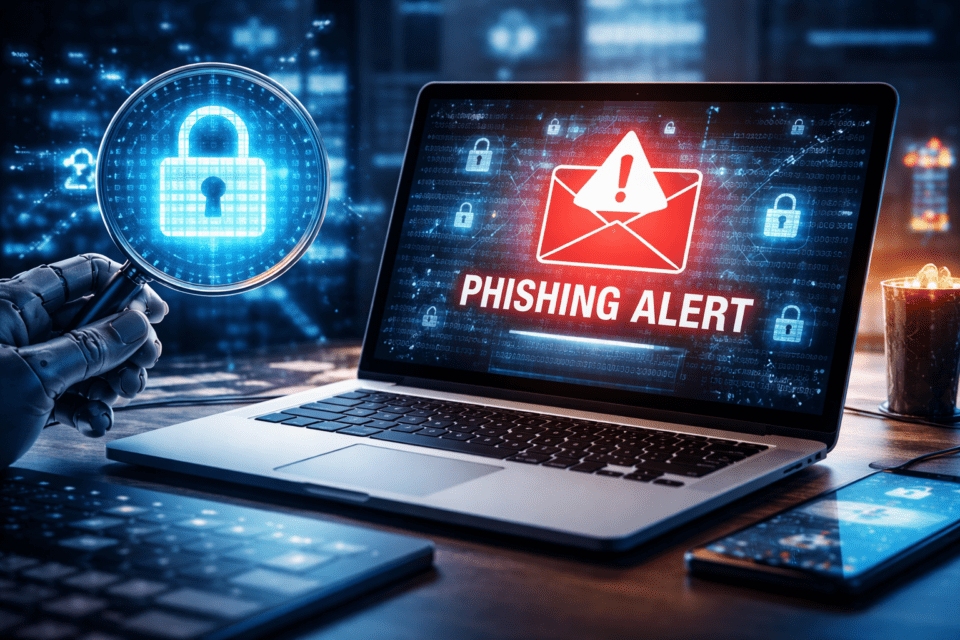
Email remains one of the primary entry points for online scams because it is inexpensive and easy to disguise as legitimate communication. According to the FBI’s Internet Crime Report 2024, the Internet Crime Complaint Center (IC3) received more than 859,000 complaints in 2024, with phishing and spoofing among the most frequently reported categories. Total reported losses from cybercrime exceeded 16 billion US dollars. These figures illustrate how widespread and financially damaging email-based fraud has become.
Phishing attacks are no longer easy to spot. They use brand impersonation, spoofed domains, cloned login pages, and increasingly AI-generated text to deceive victims. This is one of the key reasons AI-based detection systems have become increasingly important. These systems go beyond flagging obvious warning signs. They analyze patterns, intent, and behavior at scale. In this article, we look at how AI-powered scam detection tools such as Jortty operate, what they analyze, and how AI can help prevent phishing and other online scams in real-world email workflows.
In this article
What Are Email Phishing and Online Scams?
Before rushing into the discussion of the critical role of AI detection tools, we should learn what they protect us against:
- Email Phishing
Any malicious effort designed to mislead recipients, where they send emails that appear real and fool the user into disclosing personal information, such as financial information or passwords. - Spear Phishing
A sophisticated-focused form of phishing on an organization or on an individual. - Business Email Compromise (BEC)
Fraud or hacking of corporate business accounts, diversion of payments, or performing destructive commands. - Malware and Ransomware Delivery
Attackers use email attachments and links to deliver malicious software.
Traditional security measures, e.g., static span filters or signature detection, can become victims of new scam tricks. Artificial intelligence (AI) comes in where it is most needed.le.
Why Traditional Email Security Is No Longer Enough
Legacy email security solutions rely heavily on predefined rules and known threat signatures. Attackers can bypass these defenses by modifying wording, changing domains, or launching entirely new scam variants.
Human inspection alone cannot scale to thousands of emails per day. Moreover, many advanced impersonation attacks contain no obvious malicious links or attachments.
AI addresses these challenges by learning from large datasets, identifying new patterns, and detecting anomalies that static filters or manual reviews may overlook.
How AI Detects and Prevents Phishing
AI has become a central component of modern email defense systems. It combines multiple analytical methods to assess risk.
Natural Language Processing (NLP) for Email Content Analysis
Natural Language Processing (NLP) enables AI systems to evaluate wording, syntax, tone, and intent within an email. Instead of looking only for specific keywords, NLP models analyze contextual signals commonly found in phishing attempts.
AI models are typically trained on large datasets containing labeled examples of phishing and legitimate emails. Through supervised learning, the system learns to distinguish malicious patterns from normal communication. As new phishing techniques emerge, models can be retrained with updated datasets to improve detection performance.
- Flag urgent or manipulative phrasing
- Identify unusual tone shifts
- Detect inconsistencies in context
- Highlight suspicious intent
This allows organizations to identify subtle manipulations that traditional spam filters may miss.
Sender Identity and Behavioral Analysis
AI-based anomaly detection establishes a baseline of normal behavior for users and domains. This baseline can include writing style, login locations, sending frequency, and device usage.
When deviations occur—such as logins from unusual locations or unexpected changes in communication patterns—the system flags the activity for review.
- Confirm established sender patterns
- Detect unusual devices or login attempts
- Identify abnormal sending behavior
- Flag identity mismatches
This approach is particularly effective against account takeovers and Business Email Compromise schemes.
URL and Attachment Threat Detection
AI systems analyze attachments and embedded links before they reach the inbox. Suspicious files can be executed in sandbox environments to observe their behavior safely. Redirect chains and hidden payloads are examined to detect malicious intent.
- Analyze file behavior
- Scan redirect paths
- Detect concealed payloads
- Block or quarantine malicious links
This proactive scanning reduces the risk of malware infections and ransomware deployment.
Cross-Ecosystem Anomaly Detection
Beyond individual messages, AI can monitor broader communication patterns across an organization. By analyzing traffic volumes, targeted roles, and message frequency, the system can detect coordinated phishing campaigns.
- Track unusual message spikes
- Monitor role-based targeting patterns
- Identify emerging campaign trends
- Flag ecosystem-wide anomalies
This broader visibility helps organizations respond early to systemic threats.
Automated Risk Scoring and Email Filtering
Each email can be assigned a dynamic risk score based on multiple factors, including sender reputation, contextual anomalies, embedded content, and historical behavior.
- Filter automatically
- Quarantine for review
- Flag with warning banners
- Block entirely if necessary
Risk scoring reduces exposure to phishing attempts and streamlines security operations by prioritizing high-risk messages.
Real-Time User Protection and Warnings
AI systems can provide real-time alerts when users interact with suspicious content. Warning banners, click alerts, and sensitive-request notifications help users make informed decisions.
False positives can occur, and no detection system is perfect. Users should continue to verify unexpected requests and remain cautious when handling financial or credential-related messages.
Account Compromise Prevention
The AI recognizes compromised accounts based on abnormalities in their login patterns, messaging patterns, altered forward rules, and behavior inconsistencies suggestive of unauthorized access. To eliminate the possibility of additional abuse, AI initiates immediate defense measures:
- Locking accounts temporarily
- Triggering multi-factor authentication (MFA) checks
- Blocking outgoing suspicious messages
- Initiating credential resets
These measures help contain damage quickly and reduce the likelihood of internal fraud propagation. However, no system can fully guarantee protection against all attack scenarios.
Practical Implementation of AI Email Protection
Using AI email security is easy for both businesses and individual users. Key approaches include:
Integration with Email Platforms
Businesses typically deploy AI security through secure email gateways, cloud-based security services, or API integrations with platforms such as Microsoft 365 or Google Workspace. Incoming and outgoing emails are analyzed before delivery, and suspicious messages are filtered or quarantined automatically. Deployment complexity depends on organizational size and existing infrastructure. In many cases, AI-based security is integrated as an additional service layer rather than replacing existing email systems.
Deployment for Private Users
People can access AI-powered email applications or extensions that track their inboxes in real time. Suspicious links, attachments, or language patterns are identified instantly, allowing users to prevent scams and malicious content.
Real-World Example
Tools such as Jortty provide AI-powered scam protection designed to integrate with existing email workflows. These solutions scan messages, flag phishing attempts, and block malicious content while aiming to minimize disruption to everyday communication.
Best Practices
Update AI models regularly for identifying emerging phishing techniques. Combine AI detection with multi-factor authentication and educate users to handle alerts for maximum email security and reduced attack exposure.
Limitations and Ongoing Challenges
- False Positives
Even legitimate emails can be considered suspicious and interfere with regular communication. - False Negatives
Phishing attacks may go undetected, particularly those that are very sophisticated or targeted. - AI-Powered Attacks
Cybercriminals are increasingly relying on AI to create believable, convincing phishing messages, making them harder to detect. - Continuous Adaptation Needed
Protection is an ongoing process, and regular updates to models and a diligent user approach to them are necessary to stay ahead of changing threats.
Recognizing these issues, organizations can employ AI and human monitoring, ensuring a more robust, balanced approach to email security.
The Bottom Line
Both phishing and online scams have advanced from crude spam to highly targeted social engineering, often refined by AI. The ideal defensive layer for online users is identity verification, language proficiency, link and attachment analysis, and contextual anomaly detection.
AI-driven detection systems provide an additional defensive layer against phishing attacks. They help prevent or stop threats sooner, explain the risks thoroughly, and ensure consistent adaptation to the attacker’s advanced tactics.
User Review
( votes)