96 Million Devices on Mobile Networks: What the VATM Telecoms Market Study 2026 Reveals About the German IoT Market
 Dennis Knake
Posted On 12th May 2026
Dennis Knake
Posted On 12th May 2026
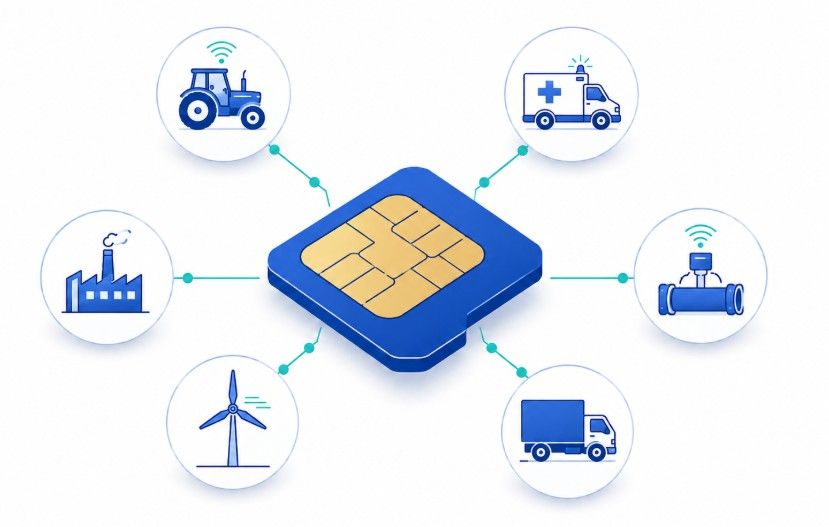
More than 96 million SIM cards will be used by machines rather than people by the end of 2026. The 27th Telecoms Market Analysis by VATM and Dialog Consult, published today, provides one of the most precise snapshots of IoT connectivity in Germany – including a 5G infrastructure gap that opens up exactly where connected sensors are needed most: in rural areas.
Key Takeaways
- By end of 2026, more than 96 million SIM cards will be used to connect machines and IT systems according to the VATM market analysis – representing growth of 12.6 percent year-on-year.
- All growth in the German mobile market now comes from the M2M segment; the consumer market is stagnating, while automotive, logistics, agriculture and industry demand ever more connectivity.
- 5G household coverage stands at 99.8 percent, but area coverage is only 96.5 percent – exactly this gap affects IoT applications in fields, forests and water pipes, with a regulatory commitment to reach 99.5 percent by 2030.
The M2M Segment Is Driving the Mobile Market
Anyone who has previously dismissed the annual telecoms market analysis by VATM and Dialog Consult as a report for telecoms insiders should take another look this year. A single figure is enough to shift the perspective: 96.4 million SIM cards will be used for machine-to-machine communication, or M2M, by the end of 2026. M2M describes the automated exchange of data between devices, sensors and IT systems without human involvement. For comparison: personally used SIM cards – everything in smartphones and tablets – total 113.6 million.
The gap is smaller than many would expect. And it is narrowing. The M2M segment is growing by 12.6 percent in 2026, while the consumer market is essentially stagnant. Study author Andreas Walter, managing partner of Dialog Consult, summed it up at the press conference on 12 May: growth in the mobile market is being driven primarily by M2M figures, with the automotive sector, logistics and all mobility-oriented industries – wherever data needs to be exchanged – as the key areas of deployment.
For IoT developers and product managers, this means the mobile infrastructure in Germany is increasingly being shaped by demand they themselves are creating.
Where the Machines Are Actually Transmitting
The VATM study does not break down the 96 million M2M SIMs by sector. However, other sources provide useful context. Vodafone, as one of Germany’s largest IoT connectivity providers, outlines concrete use cases from its own perspective in a report from July 2025: mobile ECG devices transmitting readings directly from the ambulance to the emergency room; refrigerated vehicles reporting temperature and tyre pressure via sensor to a control centre; harvesting machines with GPS navigation processing soil moisture and weather data in real time; acoustic sensors monitoring water pipes and identifying leaks before serious damage occurs.
99.8 Percent for Households – But What About the Field Next Door?
Here lies the most relevant contradiction in the study for IoT decision-makers: 5G household coverage in Germany is estimated to reach 99.8 percent by end of 2026. An impressive figure, and genuinely remarkable. Anyone living in a house in Germany can access the 5G network almost everywhere.
But machines and sensors do not only live in houses.
Area coverage still stands at 96.5 percent. Andreas Walter explicitly addressed the consequences at the press conference: “We have many applications today, in agriculture and in forestry, where mobile connectivity is needed across open land.” Network operators have committed to covering at least 99.5 percent of German territory with a minimum of 50 Mbit/s by 2030. Until then, a calculated gap of around 3.5 percentage points remains, concentrated in remote fields, forested areas and sparsely populated regions – exactly where precision farming sensors, wildfire early-warning systems and water level monitors are being deployed.
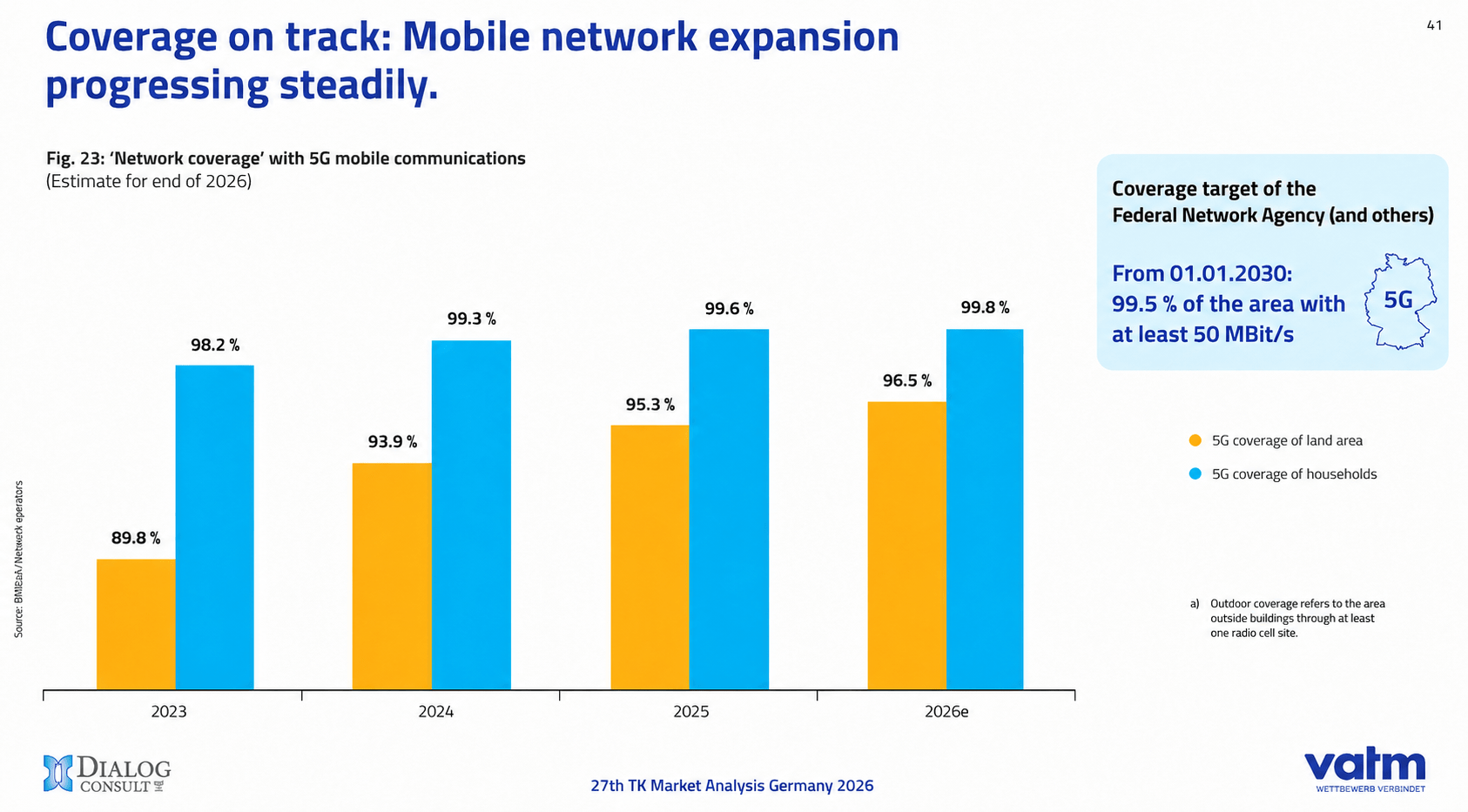
While households in Germany are already covered by 99,8 percent by the end of 2026 with 5G networks, the overall coverage of the land area is still behind with 96,5 percent. Source: 27th Telecoms Market Study VATM/Dialog Consult. Slide translated by WeSpeakIoT
For product developers building IoT solutions for these scenarios, this has practical implications for technology selection. Where LTE and 5G are not reliably available, alternative technologies are needed: LoRaWAN – a wireless network designed for very long range and minimal energy consumption, operating independently of the mobile network – is a widely used option in such scenarios. Satellite communication becomes relevant where even LoRaWAN gateways are absent. Which technology is the right fit depends on range, data volume, energy budget and available infrastructure – and must be evaluated individually for each deployment site.
The Clock Is Ticking: 2G Shutdown From 2028
For anyone still operating IoT devices on 2G, the study carries an indirect reminder. VATM data estimates 76,700 active GSM base stations in Germany through end of 2026, slightly declining. The phase-out is well underway. Deutsche Telekom has announced the complete shutdown of its 2G network by 30 June 2028. Vodafone will also deactivate its 2G services for consumer and business customers in September 2028; for particularly critical IoT applications, the network will remain available until end of 2030 under a separate contract. Telefónica has not yet announced a specific shutdown date.
According to an analysis by INSYS icom, the sectors most affected are energy supply, water management, industry and logistics – all of which have relied on GSM devices for years. Anyone still operating 2G M2M hardware in these areas has two to four years for migration, depending on their network provider. Given the long device lifecycles typical of industrial environments, that is less time than it sounds.
The technical answer is straightforward: NB-IoT and LTE-M are the direct successors for low-power scenarios with low data rates; LTE and 5G cover more data-intensive applications. The organisational answer – inventory, prioritisation, procurement, rollout – typically takes longer than the technology itself.
5G area coverage is therefore not merely a consumer supply obligation. It is a structural prerequisite for IoT deployments to function at all outside of industrial parks and city centres.
That the VATM study makes this connection visible in its figures is perhaps its most important contribution for a readership that connects machines rather than makes phone calls.

You may also like