Gartner Magic Quadrant 2026: IoT Connectivity Between Market Power and Methodology Questions
 Dennis Knake
Posted On 5th June 2026
Dennis Knake
Posted On 5th June 2026
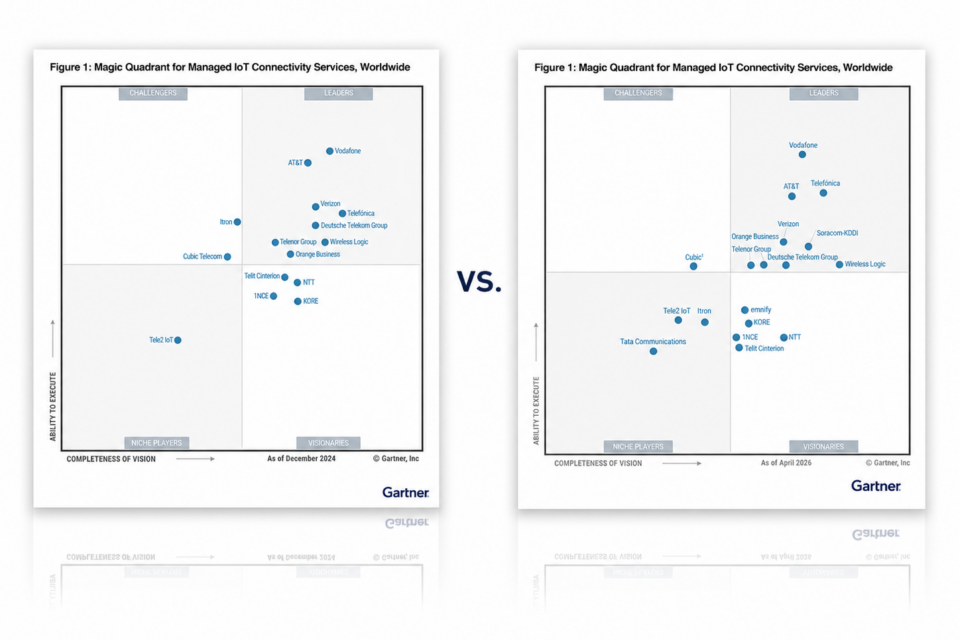
The Gartner Magic Quadrant for Managed IoT Connectivity Services was published in May 2026 – and a side-by-side comparison with the previous year is enough to see the field shifting. Who really sits at the top, why a Japanese cloud-IoT company now competes directly with global telcos, and what the quadrant reveals about the industry – and what it deliberately leaves out.
Key Takeaways
- In the 2026 Gartner Magic Quadrant for Managed IoT Connectivity Services (published May 4, 2026), Vodafone, AT&T and Telefónica retain their Leader positions for the twelfth consecutive year – new to the Leaders quadrant is Soracom-KDDI, the first fully cloud-native IoT provider to reach this level.
- The real competition is shifting away from raw SIM connectivity toward platform orchestration, AI integration, and adoption of the new eSIM standard SGP.32, which enables vendor-independent remote SIM provisioning at IoT scale for the first time.
- The Magic Quadrant is an influential but not neutral instrument: while direct pay-for-placement has been denied in court, vendors face substantial indirect costs through analyst relations programs, subscriptions, and reprint licenses – structural barriers that disadvantage smaller innovators.
Two boxes, one market report
IoT connectivity expert Sergey Ezyk posted a side-by-side comparison of the 2025 and 2026 quadrants on LinkedIn – and what at first glance looks like a slightly rearranged scatter plot tells a more telling story on closer inspection.
Vodafone continues to occupy the top-right position, with over 230 million managed connections the heavyweight of the field. AT&T and Telefónica follow closely, also recognized as Leaders for the twelfth consecutive year. AT&T claims the highest scores in five of the six evaluated use cases. Telefónica’s Kite platform, the backbone of its IoT connectivity infrastructure, now offers AI-driven automation and eSIM orchestration based on the new SGP.32 standard.
These are familiar names. More interesting is what is happening at the edges of the Leaders quadrant.
Soracom-KDDI: the newcomer with a systems mindset
Soracom-KDDI has made a leap in the 2026 quadrant that would have seemed unthinkable three years ago. The company combines two approaches: KDDI Group delivers enterprise IoT connectivity across 86 countries and territories, including connected vehicle deployments for major automakers and large-scale industrial IoT operations. Soracom itself is a cloud-native IoT platform operating in over 200 countries and territories. What sets the duo apart from traditional telcos: the business model was never built around SIM cards, but around software.
The platform connects devices directly to AWS, Azure, and Google Cloud, offers AI-driven analytics, and was one of the earliest providers to advance SGP.32-compatible eSIM orchestration. SGP.32 is the new GSMA standard for IoT eSIMs, enabling carrier profile switching over the air for the first time – without physical access to the device and without vendor-proprietary workarounds.
That a company with this profile now sits alongside Vodafone and AT&T in the Leaders quadrant is no coincidence. It reflects a structural shift in the market. emnify, a Berlin-based provider of cloud-native IoT connectivity, also makes its first appearance in the 2026 quadrant – positioned as a Visionary, meaning a newcomer with a strategically compelling vision but not yet the execution breadth of the Leaders.
Connectivity becomes infrastructure – platform becomes product
Counterpoint Research, an independent analyst firm publishing its own connectivity management platform rankings in parallel with the Gartner report, puts the trend plainly: feature differentiation among leading providers is measurably declining. Staying ahead is no longer about superior network coverage or proprietary SIM technology, but about execution speed, ecosystem breadth, and the ability to actually get complex enterprise deployments to work.
Counterpoint analyst Siddhant Cally frames it this way: the winners over the next few years will be those who can scale effectively, build the right ecosystem partnerships, and support IoT solutions across the full lifecycle – from device selection through to ongoing optimization. Connectivity, Ezyk adds in his LinkedIn discussion, is increasingly behaving like electricity from a socket: necessary, critical, and invisible to the customer – because it just works.
SGP.32: the technical foundation of platform competition
Understanding the market shift requires a brief look at SGP.32, the GSMA standard for the next generation of IoT eSIM management. Unlike the older M2M standard SGP.02, which required complex server-to-server orchestration, SGP.32 allows device-initiated profile changes – a device can autonomously switch carriers based on network quality, cost, or compliance requirements.
According to a study by Juniper Research, around 1.5 billion devices worldwide will be eSIM-capable in 2026, a 30 percent increase over the previous year. At MWC 2026, Tele2 IoT, IDEMIA Secure Transactions, and Cisco jointly presented the first commercial end-to-end SGP.32 solution – with IDEMIA reporting over 15 live deployments already in operation.
What SGP.32 means for competition: the value no longer lies in the SIM itself, but in the orchestration layer above it. Who determines when and why a device switches carriers, who writes the policy rules, and who can reliably execute that for a million devices simultaneously – that is the real platform question. And it is one that Soracom, emnify, or Wireless Logic are currently answering more convincingly in some respects than traditional network operators.
What Gartner measures – and what it doesn’t
Sergey Ezyk closed his LinkedIn discussion with a question that has simmered in the industry for years: do Gartner reports truly reflect only market share, revenue, and customer traction – or do analyst relations, PR, and marketing budgets play a significant role in positioning?
Several major players like #ChinaMobile or #AméricaMóvil don’t appear on the radar despite significant market presence. This raises an interesting question: Are some companies absent because they choose not to engage with Gartner’s evaluation process? And how much does vendor participation influence inclusion in the report? — Sergey Ezyk on LinkedIn
The formal answer is clear. The Magic Quadrant is officially not a pay-for-placement instrument: vendor briefings with Gartner are free of charge, inclusion criteria are publicly communicated, and a vendor does not need to be a Gartner customer to be included. A US court confirmed in 2014, following a lawsuit by network vendor NetScout, that Gartner does not operate a pay-to-play model.
The reality is more nuanced. Analyst relations practitioners describe the distinction clearly: vendors that want to actively improve their positioning need more analyst time – which typically only comes as a paying subscriber. This relationship allows analysts to deeply understand a vendor’s product, messaging, and roadmap. It is not direct pay-to-play, but it feels structurally similar for vendors. CMO advisor Carilu Dietrich, who published a widely read account of the MQ participation process in her Substack newsletter “Hypergrowth Leadership”, puts it directly: Gartner is not pay-to-play, it is pay-to-access.
On top of that come concrete downstream costs: any vendor that wants to use its Leader positioning in marketing materials – on their website, in presentations, in press releases – must purchase a reprint license. Practitioner sources from the AR community put these at low to mid six-figure sums, depending on scope and duration. Just participating in the MQ process ties up over 150 hours according to AR consultancy Starsight – spread across an RFI with more than 200 questions, product demos, and coordinating customer references.
Structurally, the inclusion criteria also filter out a significant portion of the market: at least 100 paying customers or five million dollars in annual revenue, plus an international customer base, are required. Innovative niche providers that are technically leading but still small simply do not appear. The picture the MQ paints is a picture of established market participants – not a complete picture of the market.
Buyers who use the quadrant know this. Yet its power as social proof is difficult to overstate: enterprise budget decisions follow the MQ more often than any other external reference point.
What decision-makers should take away now
For CTOs, IT leaders, and IoT product managers, the 2026 edition delivers three practical signals.
- Soracom-KDDI in the Leaders quadrant is not an anomaly – it signals that cloud-native providers with full platform logic are now serious competitors to global telco connectivity, especially for deployments that need to be orchestrated across multiple regions and carriers.
- SGP.32 readiness should be included in every connectivity evaluation. Anyone deploying devices today that need to run for five more years will want a provider that supports flexible carrier switching without physical intervention.
- The MQ is a good starting point, but not an endpoint. Organizations that fit precisely into a niche or are heavily focused on specific regions will be better served by a use-case-driven evaluation than by the MQ graphic alone.
The quadrant itself acknowledges these limits. Its official disclaimer states, in effect, that it does not represent an endorsement and should not be used as the sole basis for purchasing decisions. That disclaimer appears in every vendor reprint that providers pay handsomely to license.
Perhaps that is the most honest statement in the entire document.
The Gartner Magic Quadrant for Managed IoT Connectivity Services is an annual analyst report that evaluates and positions vendors in the IoT connectivity market on two axes: ability to execute and completeness of vision. It is one of the most widely referenced shortlist tools for enterprise buyers evaluating connectivity providers. The 2026 edition was published on May 4, 2026.
The Leaders in the 2026 edition are Vodafone, AT&T, Telefónica, Soracom-KDDI, Verizon, Deutsche Telekom Group, Telenor Group, and Wireless Logic. Vodafone, AT&T, and Telefónica have held Leader positions for twelve consecutive years. Soracom-KDDI is the most notable new entrant, becoming the first cloud-native IoT platform provider to reach the Leaders quadrant.
SGP.32 is the GSMA standard for the next generation of IoT eSIM management, designed specifically for headless devices such as sensors, meters, and trackers that have no screen and limited power. It allows network profiles to be managed remotely from a central platform across entire device fleets, without physical SIM access or vendor lock-in. Juniper Research projects 1.5 billion eSIM-capable devices globally by end of 2026, making SGP.32 readiness an increasingly relevant criterion when evaluating IoT connectivity providers.
A US court ruled in 2014, following a lawsuit by network vendor NetScout, that Gartner does not operate a pay-to-play model — vendor briefings are free and inclusion criteria are publicly communicated. In practice, however, improving a position in the quadrant typically requires sustained analyst engagement through a paid Gartner subscription. Additionally, vendors must purchase a reprint license to use the MQ graphic in their own marketing materials, with costs reported by AR practitioners at six-figure sums. The process also demands over 150 hours of participation. Industry insiders commonly describe it not as pay-to-play, but as pay-to-access.
Inclusion in the Magic Quadrant requires meeting specific criteria, including a minimum of 100 paying customers or five million dollars in annual revenue and an international customer base. Beyond eligibility, active participation in Gartner’s evaluation process — including completing a detailed RFI, providing product demos, and coordinating customer references — is required. Some large operators with significant regional presence may choose not to engage with the process, or may not meet the international distribution criteria. As a result, the Magic Quadrant reflects established participants in the process, not a complete picture of the global market.
Three signals stand out. First, cloud-native providers like Soracom-KDDI are now credible alternatives to global telcos for multi-region IoT deployments. Second, SGP.32 readiness should be included in any connectivity evaluation for devices with a lifespan of several years. Third, the Magic Quadrant is a useful starting point for shortlisting but not a substitute for a use-case-driven evaluation — vendors with strong niche expertise or regional focus may not appear in the quadrant at all.