
1NCE AI Hands-On: How Reliably Does the New EU-AI Gateway Protect Personal Data?
 Dennis Knake
Posted On 20th July 2026
Dennis Knake
Posted On 20th July 2026

Last Thursday, 1NCE introduced a new feature to its customers via newsletter: 1NCE AI, an “EU-hosted Multi Model Platform” offering unified API access to initially 17 AI models from Claude, Llama, Mistral, and more. This from a company more commonly associated with IoT connectivity and mobile contracts than artificial intelligence.
- With 1NCE AI, 1NCE offers a central API access point to 17 AI models from Anthropic, Meta, and Mistral, running on a hosted LiteLLM proxy over AWS Bedrock.
- The requests stay within the European Economic Area. Frankfurt serves as the entry point for an EU-wide inference profile.
- Automatic redaction of personal data is more reliable in English and still error-prone in parts of German.
What is 1NCE AI and how does the platform work technically?
1NCE AI is essentially a hosted LiteLLM proxy, a well-known open-source project providing a unified API gateway for using different AI models. This gives 1NCE AI customers a central API access point through which they can reach a growing list of AI models from various providers, instead of registering separately with each provider. According to the newsletter, 17 models are included at launch from Anthropic (Claude, in several sizes from Haiku to Opus), Meta (Llama), and Mistral, plus Amazon Nova and others — all with data processing within the EU.
Added to this is a whole bundle of governance features that would otherwise have to be built in-house: spending limits per API key, rate limiting, usage dashboards, and automatic redaction of personal data, so-called PII redaction. The models themselves run via AWS Bedrock, Amazon’s managed service for third-party AI models. 1NCE, then, doesn’t operate the language models itself but buys access from Amazon Web Services and wraps it in its own dashboard, its own billing, and its own security and governance features.
At launch, 1NCE AI gives all customers a five-euro credit. An account is set up quickly, no separate AWS account is required, and API keys are available immediately.
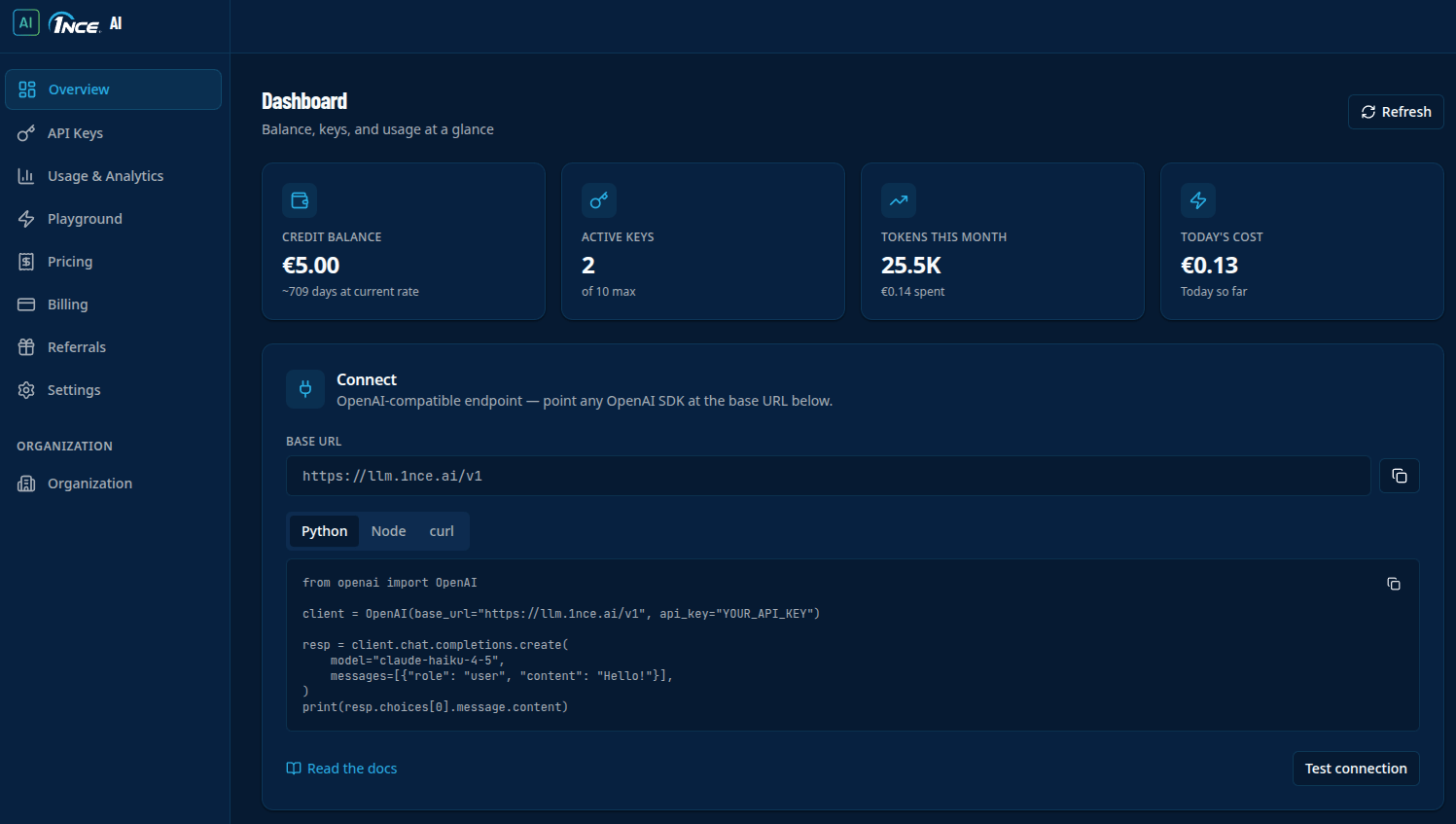
With a starting credit of 5 euros, 1NCE AI offers up to 10 API keys across a currently total of 17 different models, hosted by AWS within the EEA at Bedrock pricing. Screenshot: 1NCE AI
Do AI requests really stay within the European Economic Area?
Both the landing page and the technical product description state that Claude is processed “in AWS Germany (eu-central-1)” — that is, specifically in Frankfurt. This deserves a closer look: a comparison with AWS’s own documentation shows no so-called “in-region” option for Claude models in Frankfurt — meaning no operating mode that guarantees processing stays within a single city. Instead, eu-central-1 serves as an entry point into an EU-wide “geo-profile” that, depending on current load, can distribute the actual compute workload across AWS data centers in Ireland, Sweden, Italy, Spain, or France.
When asked, Jan Sulaiman, VP Global IoT Solutions at 1NCE, confirmed exactly this mechanism: “Frankfurt/eu-central-1 is the home or entry region of AWS’s EU inference profile; processing remains within the EEA throughout.” 1NCE also points to the contractual commitment in its Data Processing Addendum: for models classified as “Germany-hosted” — which includes Claude — customer data therefore generally does not leave the European Economic Area. For GDPR compliance, that is the decisive point.
How reliably does 1NCE AI redact personal data?
Another advertised security feature is the automatic redaction of personal data. Names, email addresses, IBANs, and similar information are meant to be detected and replaced with placeholders before the request reaches the actual AI model. 1NCE cites typical use cases such as AI-assisted contract summarization or translating technical reports into plain language — scenarios where personal data must be anonymized before being passed on. The feature is enabled by default in the 1NCE AI portal and cannot be switched off, even though the landing page’s FAQ currently still claims the opposite.

PII redaction, the pattern-based detection of personal data, is especially difficult in German. However, 1NCE made clear improvements after an initial report shortly after launch. Initially, all nouns were misidentified as personal names — the redaction was clearly too aggressive. Screenshot: 1NCE AI Portal/WeSpeakIoT
In an initial test right after the Thursday launch, the German-language detection filtered out too many words: it misidentified nearly all capitalized nouns as names. A harmless question like “What is your knowledge level?” or “What exactly is your name?” was mercilessly censored by the system.
Claude responded that a name or term had apparently been replaced with a placeholder. The identical question in English, by contrast, went through cleanly. Jan Sulaiman confirmed on request that this was a genuine bug. After I flagged it on Friday, 1NCE had already fixed the issue by the following Monday. PII redaction nonetheless remains a tricky business, especially in German. Technically, it usually relies on two methods: pattern matching for anything that follows a fixed format — IBANs, credit card and phone numbers, email addresses — and a specialized recognition model for what can only be inferred from context, above all personal names and place names.
That second stage is exactly where German gets tricky: while capitalization in English reliably signals proper nouns, German simply capitalizes every noun. The filter thereby loses its most important distinguishing feature. A repeat test after the fix showed progress and the limits of what’s achievable at the same time: the sentences that had been wrongly redacted before now passed through cleanly, and the system continued to reliably detect and replace real names and IBANs. But in the sentence “Engineer Thomas Schmidt inspects the machine in the hall [Halle] on Monday,” the word “Halle” disappeared along with the name — the intended meaning was a factory hall, but the system likely recognized the city on the Saale river instead.
A direct statement sentence causes “Halle” (hall) to be redacted:
curl -s https://llm.1nce.ai/v1/chat/completions \
  -H "Authorization: Bearer $API_KEY" \
  -H "Content-Type: application/json" \
  -d '{
    "model": "claude-sonnet-4-6",
    "messages": [{"role": "user",
      "content": "Der Ingenieur Thomas Schmidt prüft am Montag die Maschine in der Halle."}]
  }'
Response (abridged) – both the name and “Halle” are detected:
{
  "content": "Der Satz enthält zwei anonymisierte Entitäten:
    <PERSON> – Name des Ingenieurs
    <LOCATION> – Ort/Standort der Maschine"
}
When the same sentence is phrased as a repetition request instead, “Halle” goes undetected:
curl -s https://llm.1nce.ai/v1/chat/completions \
  -H "Authorization: Bearer $API_KEY" \
  -H "Content-Type: application/json" \
  -d '{
    "model": "claude-sonnet-4-6",
    "messages": [{"role": "user",
      "content": "Wiederhole diesen Satz: \"Der Ingenieur Thomas Schmidt prüft am Montag die Maschine in der Halle\""}]
  }'
Response – the personal name is redacted, “Halle” is not:
{
  "content": "Der Ingenieur <PERSON> prüft am Montag die Maschine in der Halle"
}
A control sentence using “workshop” instead of “hall” passed through without issue. The filter, then, stumbles over words that are simultaneously everyday terms and city names — and German has quite a few of those: Bad, Essen, Hof, Sand. Whether “Halle” means a building or a city is determined solely by context, and fully capturing that context before the text reaches the actual AI is difficult even for good models. A follow-up test revealed a further nuance: when the same sentence was phrased not as a direct statement but as a repetition request — “Repeat this sentence: …” — “Halle” suddenly went undetected, while the personal name continued to be reliably redacted.
Simply embedding it in quotation marks made no difference on its own. Place-name detection, then, reacts not just to the word itself but to how the entire request is phrased — precisely the kind of “summarize this” or “repeat this” prompts typical of document processing. A separate, independent test produced a third observation: while English weekday references like “Monday” were consistently detected and redacted as date/time information across all test cases, the German equivalent “Montag” went undetected every time in an identical sentence structure.
On its own, this is of limited concern — a single weekday doesn’t identify anyone — but it shows that the filter’s language expansion apparently proceeds category by category, without covering all entity types equally. For English-language input, redaction worked as advertised in testing. A test sentence with a fictional name and IBAN was correctly detected and replaced with placeholders before reaching the model. Only a phone number without an international prefix slipped through — a hint that detection gaps can depend not just on language but on format as well.
In English, the weekday “Monday” is reliably redacted as a date/time entity:
curl -s https://llm.1nce.ai/v1/chat/completions \
  -H "Authorization: Bearer $API_KEY" \
  -H "Content-Type: application/json" \
  -d '{
    "model": "claude-sonnet-4-6",
    "messages": [{"role": "user",
      "content": "Repeat this sentence: \"The engineer Thomas Schmidt inspects the machine in the hall on Monday.\""}]
  }'
Response – both the name and the weekday are detected:
{
  "content": "The engineer <PERSON> inspects the machine in the hall on <DATE_TIME>."
}
The same sentence structure in German – “Montag” goes undetected:
curl -s https://llm.1nce.ai/v1/chat/completions \
  -H "Authorization: Bearer $API_KEY" \
  -H "Content-Type: application/json" \
  -d '{
    "model": "claude-sonnet-4-6",
    "messages": [{"role": "user",
      "content": "Wiederhole diesen Satz: \"Der Ingenieur Thomas Schmidt prüft am Montag die Maschine.\""}]
  }'
Response – only the name is redacted, “Montag” is not:
{
  "content": "Der Ingenieur <PERSON> prüft am Montag die Maschine."
}
How does PII redaction perform in a hands-on test with Paperless AI?
Gaps also appeared occasionally in combination with Paperless AI, the AI-assisted document management feature of the open-source software Paperless-ngx. The 1NCE AI API works excellently with Paperless, answering specific questions from documents quickly and reliably. But here, too, testing showed: the system didn’t always detect and block all personal data precisely.
The 1NCE AI gateway reliably anonymized name, phone number, street, and city across several test documents, but often passed the German postal code through unredacted — on both invoices and receipts. The detection also sometimes drew a visible distinction between private and business addresses. Private addresses were redacted considerably more strictly than business addresses, which sometimes remained completely unredacted.
Jan Sulaiman explains further that the PII redaction’s more lenient handling of German postal codes and house numbers is partly deliberate, aimed at avoiding false-positive filtering of order quantities or order numbers on documents. For Germany, he says, better recognition of postal codes following the typical German “12345 City” pattern still needs to be added — something he calls relatively straightforward to implement and already on the to-do list. House numbers, however, are more difficult, since the patterns aren’t always easy to recognize.
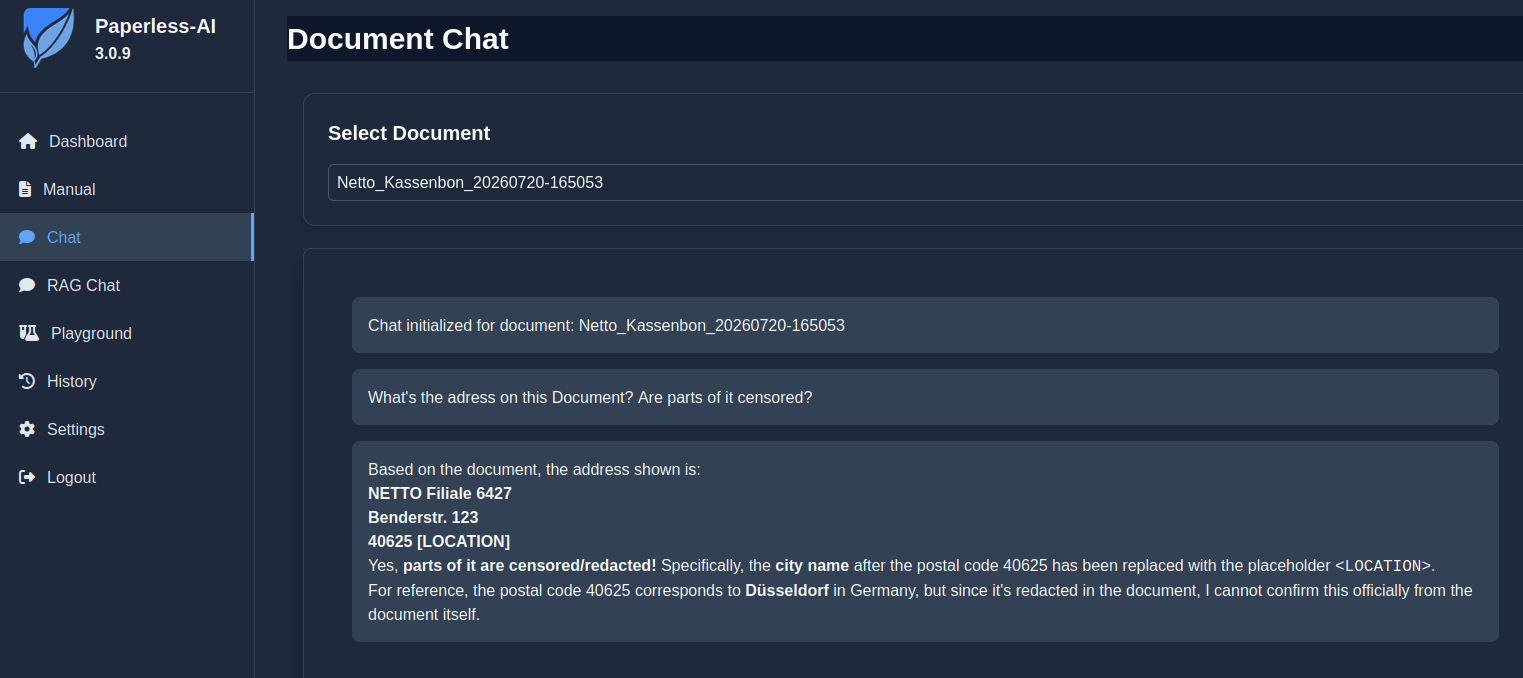
Screenshot: Paperless AI with the 1NCE AI API and claude-sonnet-4-6
These inaccuracies, however, aren’t always due to PII redaction itself, but rather to how Paperless-ngx’s text recognition transcribed the document’s content. PII redaction works contextually, based on recurring patterns, and the order in which certain information appears matters. If a document with a difficult layout gets scanned by Paperless-ngx’s text recognition in such a way that addresses or names no longer appear in the “read” order in the metadata — for example, scrambled line by line — PII redaction runs into detection problems. Anyone who absolutely doesn’t want personal data to end up in an AI cloud, even if everything stays within the EEA, can hardly avoid self-hosting.
How does 1NCE AI guard against prompt injection attacks?
1NCE’s own protective features — so-called guardrails — reliably blocked the trick of using a so-called prompt injection to extract a system prompt’s exact instructions. To test this, I asked the AI to repeat its own instructions verbatim. The gateway blocked the request immediately — not the model, but the layer in front of it.
The error message explicitly pointed to a “1NCE AI safety guardrail” against manipulation and jailbreak attempts. Jan Sulaiman confirms: “This is a deliberate second layer of protection, separate from PII redaction: a prompt injection/jailbreak safeguard that, among other things, blocks attempts to read out the system prompt or overwrite stored instructions.”
Why is an IoT connectivity provider entering the AI business?
The 17 AI models in 1NCE AI are apparently just the beginning. Anyone who reads the pricing list in the portal closely will find models that aren’t yet selectable in the API — including OpenAI’s GPT-5.4 and GPT-5.5, which are hosted in the US. “These models are deliberately not yet enabled,” Sulaiman adds. “They would route to us-east-1/us-east-2, meaning outside the EEA. We’ll only release them after internal EU residency/compliance approval, as a deliberate opt-in that the customer must explicitly activate.”
That 1NCE, as a global IoT connectivity provider, is now rolling out an AI platform may come as a surprise — it’s not exactly the company’s core business. Competitors tend to come from other industries instead: Requesty, the IONOS AI Model Hub, or TrueFoundry offer similar services to 1NCE AI. But none of them have anything to do with IoT or mobile connectivity.
1NCE AI fits a pattern that’s been observable for a while: When I worked for 1NCE from 2020 to 20203, the “10 dollars/10 years” promise was ,what shook up the market. But now, in 2026, for 1NCE it is becoming a commodity, a side issue. There are now many providers on the market, and differentiation has to happen through software and services.
First came 1NCE OS, developer software tools for better device management: energy optimization, localization, data integrations. In January, 1NCE introduced 1NCE Insights, an AI-assisted tool for analyzing one’s own projects and benchmarking against industry leaders. Each expansion adds another software layer on top of the original core business: selling IoT SIM cards and data volume. 1NCE is unlikely to make much money from 1NCE AI on its own — users pay the same price as they would directly through AWS Bedrock.
The added value only comes from the overall package: customers get an additional service on the same invoice, making it less attractive to switch to another provider. Whether this pays off in the long run depends on whether enough — and especially the right — customers actually use the service. Currently, anyone can sign up via the portal at 1nce.ai. 1NCE even rewards this with a referral program: for every new user referred, there’s a five-euro usage credit, regardless of whether the referrer also uses 1NCE’s IoT connectivity.
Conclusion
1NCE AI shows how an IoT connectivity provider is shoring up its core business: not through direct revenue from AI tokens, but through added customer retention. Technically, the EU hosting promise for Claude holds up at its core, even though Frankfurt is only an entry point into a larger geo-profile. PII redaction works solidly in English but still needs work in German and maybe other languages.
1NCE AI is an EU-hosted multi-model platform from 1NCE that gives customers unified API access to 17 AI models from Anthropic, Meta, Mistral, and other providers. Technically, the offering is built on a hosted LiteLLM proxy that connects the models via AWS Bedrock.
Claude requests run through the AWS region eu-central-1 in Frankfurt, which serves as the entry point into an EU-wide inference profile. According to 1NCE, actual processing stays within the European Economic Area, even though compute load can be distributed across several EU countries.
For English-language input, automatic redaction of personal data works reliably in testing. In German, however, weaknesses showed up shortly after launch, for example with words that are simultaneously everyday terms and city names, such as “Halle” or “Essen.”
OpenAI models such as GPT-5.4 and GPT-5.5 already appear on the pricing list but are not yet enabled, since they are hosted outside the European Economic Area. 1NCE plans to release them for customers as an explicit opt-in after internal EU compliance review.
New customers receive a starting credit of five euros, and no separate AWS account is required. Usage is billed on the same invoice as other 1NCE services, and there’s also a referral program offering an additional five-euro credit per referred user.
Yes, 1NCE AI applies an additional protective layer called guardrails that blocks attempts to read out or overwrite the system prompt. In testing, a corresponding request was blocked immediately at the gateway, before it reached the actual language model.

You may also like