Connectivity Is the Entry Ticket, Not the Prize: What Gartner’s 2026 IoT Magic Quadrant Tells Us About 2027’s Leaders
 Sergey Ezyk
Posted On 25th June 2026
Sergey Ezyk
Posted On 25th June 2026

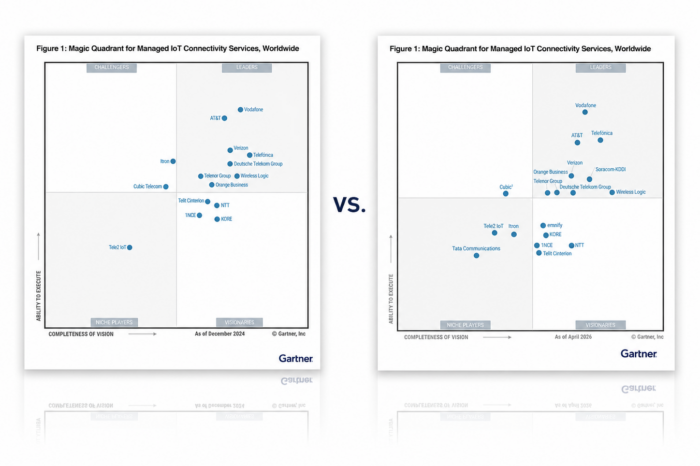
IoT connectivity has quietly become a commodity. Coverage, eSIM, multi-network support, and connectivity management platforms (CMP) are now table stakes that most leading providers offer in some form. The real question Gartner’s 2026 Magic Quadrant is asking — and the one that will decide who becomes a Leader by 2027 — is who can turn that infrastructure into measurable business outcomes at global scale.
- Gartner’s 2026 Magic Quadrant for Managed IoT Connectivity Services shifts emphasis from technology breadth to execution, orchestration, and business outcomes.
- Among this year’s Visionaries and Challengers, NTT and emnify are seen as closest to Leader status by 2027, but architecture alone will not get them there — global execution will.
- Several capable connectivity providers, including regional specialists and MVNOs, do not appear in the Magic Quadrant at all, which says more about evaluation scope than about market reality.
Connectivity is no longer the differentiator
For most of the past decade, IoT connectivity providers competed on coverage, network breadth, and price per SIM. That race is largely over. Most established providers now offer comparable coverage, eSIM support, multi-network access, and CMP tooling. The capability that used to separate vendors has become baseline infrastructure.
What has changed is the question enterprise buyers ask. It used to be “can you connect my devices?” Now it is closer to “can you simplify global deployment, reduce operational cost, ensure regulatory compliance, and integrate into my existing IT landscape?” Connectivity remains essential, but it has moved from being the product itself to being the foundation underneath the product. The differentiator has shifted toward service quality, automation, ecosystem integration, and consistent execution.
What is Gartner evaluating differently in 2026?
This shift shows up directly in how Gartner’s 2026 Magic Quadrant for Managed IoT Connectivity Services weighs its criteria. Compared to previous years, the evaluation leans more heavily toward the ability to deliver globally, support large enterprise deployments, build strategic ecosystem partnerships, and execute consistently across regions — rather than purely technical capability.
IoT connectivity is also no longer assessed as a standalone product. Increasingly, it is one component of a broader digital transformation platform that combines connectivity, device management, security, analytics, and AI-driven operations. A provider with excellent connectivity but a weak surrounding platform is, in Gartner’s current framing, a weaker proposition than one with broader orchestration capability — even if its core network coverage is less extensive.
| NTT | emnify | KORE | Telit Cinterion | Cubic³ | 1NCE | |
|---|---|---|---|---|---|---|
| Final Verdict | ||||||
| The most Leader-like | 2nd most credible | ———- The debated middle ———- | Furthest from Leader | |||
| Likelihood of Becoming a Leader in 2027 | ||||||
| Open AI GPT 5.2 | 60–70% | 40% | 30–40% | 20% | 30% | <10% |
| Claude Sonnet 4.6 | 80% | 30% | 40% | 20% | 10% | 10% |
| Mistral Medium 3 | 70–80% | 50–60% | 30–40% | 10–20% | 20–30% | <10% |
| Google Gem 2.5 Pro | 75% | 55% | 35% | 15% | 25% | 5% |
| Gap with Leaders in 2026 | ||||||
| Market vision | ✅ Strong enterprise-facing vision around end-to-end IoT, and vertical solutions | ✅ Strong cloud-native platform, hybrid networks, AI, and SGP.32 orchestration | ⚠️ Strong orchestration & standards, industry scope, execution lagging | ⚠️ Coherent but selective; strong in secure enablement, less broad in NGN ambition | ⚠️ Clear and innovative vision, but too concentrated in automotive | ❌ Strong LPWAN-focused vision, but major gaps in 5G, MPN, orchestration |
| IoT Product or Service continuum | ✅ Strong stack; MPN 4G/5G, edge & AI; missing NB-IoT and satellite | ✅ Strong platform cloud-native and AI-oriented service breadth | ⚠️ Good orchestration and integration breadth, but less clearly end-to-end | ⚠️ Full IoT MVNO, cloud-native connectivity; solid but hardware-led | ⚠️ Broad 5G NSA coverage via partners; integrated NTN; no 3GPP LPWAN | ❌ Low and mid-data focus, NB-IoT & LTE-M; no 5G |
| Sales strategy and execution | ✅ Robust execution for multinational deployments | ⚠️ Held back by lower growth and indirect-channel reliance | ❌ Constrained by low growth, reduced resources, limited 5G deployment | ⚠️ Solid but hardware-led | ⚠️ Strong momentum in chosen, but not broad execution | ❌ Scale growth, broader support / pro services, but sustainability concerns |
| Customer experience | ✅ Unified support and global technical/commercial coverage | ✅ Strong digital support with AI-assisted ops, real-time capabilities | ✅ Good self-service and support tooling, esp. for SMBs and developers | ✅ Strong deployment support, broad customer coverage in core regions | ❌ Missing physical field/on-site support | ⚠️ Less evidence of broad service depth than top-ranked vendors |
| Multiple geographies | ⚠️ Scale is still concentrated in APAC and Europe | ⚠️ Limited direct sales outside Europe and Americas | ⚠️ Weakened sales/support capacity outside core regions | ⚠️ Still concentrated in North America and Europe | ❌ Outside Europe and North America is still very limited | ✅ Broad multinational footprint, active expansion |
| Size and scale | ✅ Enterprise breadth, multinational structure | ⚠️ Heavy indirect channels dependence | ✅ Broad integration scale & global footprint | ✅ Solid commercial & deployment scale | ⚠️ Narrower segment and geo limit broader scale | ⚠️ Broader enterprise/service scale is less explicit |
Which Visionaries and Challengers could become Leaders by 2027?
Predicting where a market moves in twelve months is inherently speculative — which is one reason I tested the question against four AI models (OpenAI GPT 5.2, Claude Sonnet 4.6, Mistral Medium 3, and Google Gemini 2.5 Pro) rather than relying solely on my own read. Their independent estimates converged more than they diverged, though not completely.
NTT emerged as the strongest candidate across all four models, with probability estimates for reaching Leader status by 2027 ranging from 60–70% to 80%. The reasoning was consistent: strong enterprise-facing vision, a broad IoT product stack spanning private 4G/5G, edge, and AI, and — critically — execution that already works across multinational deployments.
Emnify came second, but here the models disagreed more sharply, with estimates ranging from 30% to 55–60%. The case for emnify rests on product architecture: a cloud-native, API-first platform with strong AI-oriented service design. The case against is execution — emnify’s growth and direct sales reach outside Europe and the Americas remain more limited than NTT’s. That divergence between models is itself informative: where AI models disagree, it usually signals that the market itself hasn’t decided yet.
KORE, Telit Cinterion, and Cubic³ occupy what I’d call the debated middle. KORE has breadth but insufficient momentum. Telit Cinterion is technically strong but functions more as an enabler for other companies’ platforms than as a market shaper in its own right. Cubic³ executes well but remains concentrated in automotive, which limits its path to a broader Leader position.
1NCE remains the most disruptive of the group on pricing and simplicity, but its LPWAN-centric focus — without broader 5G, private network, or orchestration capability — keeps it furthest from Leader territory for now. The pattern across all four models points to one conclusion: the next Leaders are unlikely to be the providers with the longest feature list. They will be the ones that execute operationally at scale.
Why does execution matter more than product architecture?
A strong connectivity management platform is only one part of a successful IoT deployment. Global projects have to navigate local regulations, permanent roaming restrictions, mobile network agreements, regional certifications, security requirements, and long-term operational support across dozens of countries — none of which is solved by better software architecture alone.
In practice, technology rarely causes IoT projects to fail. Operations do. I’ve seen technically strong solutions delayed because device certification in a specific market took longer than planned, or because a customer underestimated the operational effort of managing thousands of SIMs across multiple regulatory environments — even though modern CMPs have significantly reduced that complexity compared to a few years ago.
The harder challenge usually sits elsewhere: integrating connectivity into enterprise IT systems, coordinating multiple ecosystem partners, managing device lifecycles, and keeping operations consistent across very different regulatory and commercial environments. There’s also a scaling cliff that’s easy to underestimate. Connecting 500 devices in a pilot is straightforward. Connecting 500,000 devices across 40 countries while maintaining compliance, predictable costs, and reliable operations is a fundamentally different problem — and it’s the problem that actually separates Visionaries from Leaders.
Are there capable IoT connectivity providers Gartner’s Magic Quadrant misses?
Yes — and that’s not a flaw in the Magic Quadrant so much as a reflection of its scope. The IoT connectivity market remains diverse. Some providers focus on global enterprise deployments; others specialize in specific industries, regions, or use cases. Large MNOs with strong domestic positions, specialized MVNOs, and dedicated NTN (non-terrestrial network, i.e. satellite-based) connectivity providers all operate in this space without necessarily meeting the Magic Quadrant’s inclusion criteria.
América Móvil and China Mobile bring strong domestic and regional reach; BICS focuses on wholesale and roaming infrastructure; Eseye, floLIVE, Onomondo, Teal Communications, and Velos IoT each serve specific enterprise IoT niches with platforms built around particular deployment models or geographies. A provider’s absence from the quadrant is more often a function of evaluation scope, market focus, or business strategy than a lack of capability.
For an enterprise evaluating partners, the more useful question isn’t “who’s missing from the ranking?” but “which provider’s deployment model, geographic footprint, and operational requirements actually match mine?” Rankings are a starting point for that conversation, not a substitute for it.
How should enterprises use AI in vendor evaluation — without over-relying on it?
AI is a useful starting point for vendor evaluation, not a final answer. Models can hallucinate, miss recent developments, or lack company-specific context — all real limitations worth taking seriously. The way to get value out of them is to feed them better inputs than a single analyst report: additional analyst coverage, customer references, and your own requirements, and to define your own evaluation criteria around geography, technology stack, use case, and commercial priorities rather than accepting a generic framework. Used this way, AI is good at producing a longlist quickly. Human expertise is what turns that longlist into a shortlist — and talking to two or three shortlisted vendors directly, with open-ended questions, is still what closes the gap that no model can. AI accelerates vendor evaluation. Human judgment makes the final call.
Conclusion
The providers already holding Leader positions in Gartner’s 2026 Magic Quadrant aren’t immune to this shift either. Even the most secure among them carry their own gaps — orchestration roadmaps still maturing, satellite and 5G execution lagging behind vision, end-to-end offering gaps still being closed. Leader status in 2026 is a snapshot, not a guarantee for 2027. For the Visionaries and Challengers discussed here, the path to Leader status runs through the same test the current Leaders are still working on: turning architecture into consistent, global, operational delivery. The vendor with the most complete product roadmap won’t necessarily win that race. The one that can execute it everywhere, reliably, will.
The author works for Orange Business, which holds a Leader position in the Gartner Magic Quadrant discussed in this article. This piece reflects his personal analysis and does not represent Orange’s official position.
It doesn’t mean connectivity has lost value, but that it’s no longer the main differentiator. Coverage, eSIM, multi-network support, and CMP tooling have become standard across most leading providers. The competitive edge has shifted toward service quality, automation, ecosystem integration, and consistent execution.
The 2026 evaluation shifts emphasis from technology breadth toward execution and business outcomes. Gartner weighs global delivery capability, enterprise deployment support, ecosystem partnerships, and consistent execution across regions more heavily. IoT connectivity is also assessed as part of a broader platform combining connectivity, device management, security, analytics, and AI-driven operations, rather than as a standalone product.
Based on an analysis combining four AI models with practitioner judgment, NTT is seen as closest to Leader status, followed by emnify. KORE, Telit Cinterion, and Cubic³ occupy a more debated middle ground, while 1NCE remains furthest from Leader territory due to its narrower LPWAN focus. These are probability-based estimates, not certainties — the next twelve months of execution will decide the outcome.
A strong connectivity platform is only one part of a successful global IoT deployment. Local regulations, permanent roaming restrictions, regional certifications, and long-term operational support across dozens of countries are operational challenges that good architecture alone doesn’t solve. Customers consistently choose providers that can deliver reliably across complex international environments, even when a competitor’s platform is technically a bit stronger.
The Magic Quadrant offers valuable market insight, but it isn’t an exhaustive list of capable providers. Many regional specialists, MNOs, MVNOs, and niche connectivity platforms deliver strong results within specific industries or geographies without meeting the quadrant’s inclusion scope. The best partner for a given enterprise is the one whose capabilities match its operational, commercial, and geographic requirements — not necessarily the highest-ranked name.