
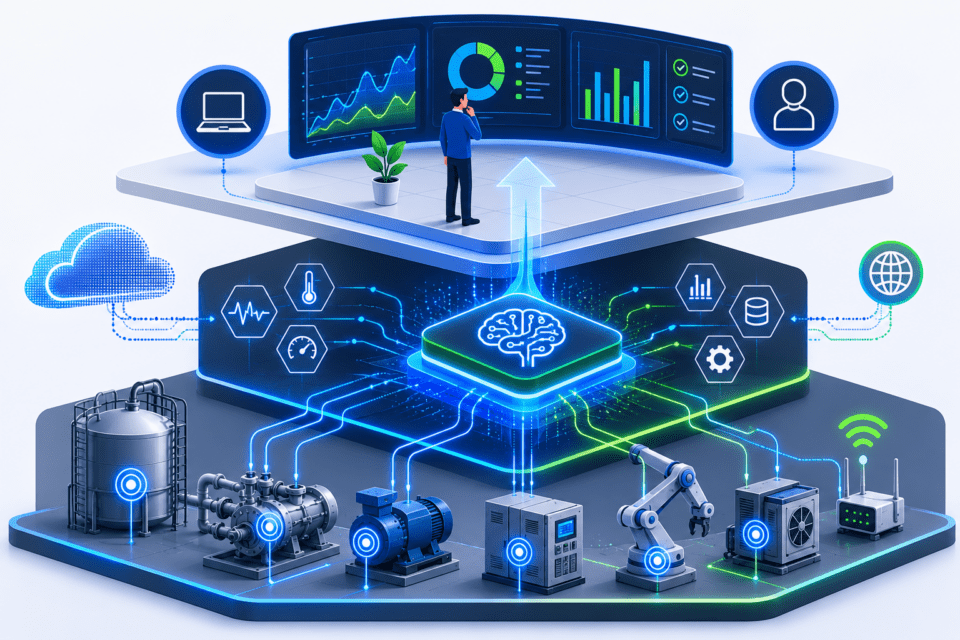
Sensors measure, networks transmit, dashboards fill up – and then someone eventually takes a look. In many IoT installations, humans are still the only link between data and decision. AI agents can take on this role, provided companies create the right conditions.
- AI agents are not simple chatbots, but autonomous systems that access data sources, prepare decisions and execute processes independently – including in IoT environments.
- Structured prompting – for example using the RACE framework (Research, Analyze, Communicate, Execute) – and continuous testing are the foundation for reliable results.
- Without AI governance and a “human in the loop” – meaning organisationally anchored human oversight – hard-to-control risks emerge in networked systems.
From Sensor to Decision – What Is Still Missing?
IoT, the Internet of Things, works on a simple principle: sensors capture states, devices transmit data, systems respond. In theory. In practice, temperatures, fill levels, machine parameters and motion data end up in dashboards that someone has to review manually on a regular basis. The human remains the link between data point and action.
AI agents are not the missing piece of sensor technology or connectivity. They are the analytics and control layer that has remained analogue in many IoT installations to this day.
A Digital Employee with a High Tolerance Threshold
An AI agent is not an assistant that answers questions. It is a system given goals, rules and data sources – and which acts autonomously on that basis. An ERP system, a machine database or an IoT gateway can all be connected as information sources. The agent then knows whether to ask follow-up questions, which rules to follow and in which format to deliver results.
The difference from a simple automation script lies in flexibility: an AI agent can handle unstructured data, recognise patterns and provide context-based assessments in edge cases, rather than simply triggering a hardcoded threshold.
This analogy came from a customer workshop and hits the mark: repetitive tasks that people dislike doing – and consequently do less carefully – are precisely the use case AI agents are built for.“An AI agent is like a working student with a high tolerance threshold. They get a research task or are asked to summarise certain information. It is a bit tedious, but they do not feel bad about it and always complete their tasks reliably.”
Concrete Use Cases in Networked Systems
Use cases range from automated invoice processing to the evaluation of quarterly KPIs directly from an ERP system. In IoT environments, further possibilities open up: quality assurance, energy monitoring, plant surveillance. The underlying principle is always the same – structured input data, a clearly defined verification process, a result with an action recommendation. The only difference is that the input comes from a sensor, not an inbox.
The key is to avoid setting unrealistic expectations. An AI agent does not write maintenance orders or make business decisions. It prepares them, flags anomalies – and in doing so relieves the people who actually make those decisions.
Setup: Choosing, Testing and Improving a Prompting Framework
Anyone developing an AI agent for IoT tasks needs to engage with prompting – the question of how to communicate goals, context and behavioural rules to an AI system. This step sounds technically trivial, but it is the decisive quality lever.
Several established frameworks exist. For decision-making processes from information gathering through to implementation, RACE (Research, Analyze, Communicate, Execute) is a strong fit. For clearly scoped analysis tasks with a defined output, R-A-F (Role, Action, Format) works well. Data-driven process optimisation with ongoing monitoring is well served by DMAIC (Define, Measure, Analyze, Improve, Control).
“Building a good AI agent does take some work. The initial effort is greater than most people expect.”
On top of the framework come training tasks and ongoing quality checks of the output. Anyone who skips this step ends up with a system that appears reliable – until it no longer is. It also pays to involve the AI itself in the development process: plan for multiple feedback loops and improve prompts iteratively.
Important Prompt Frameworks in IoT Applications
| Model | Benefit in IoT Context | Example: Predictive Maintenance |
|---|---|---|
| RACE Research Analyze Communicate Execute | End-to-end decision processes: from raw data capture to automated action | Research: Collect sensor data from machine park (vibration, temperature, pressure) Analyze: Detect anomalies in vibration pattern, compare with thresholds Communicate: Report the affected unit with fault description and urgency level to the maintenance team Execute: Trigger preventive maintenance order in CMMS, lock down unit if critical |
| R-A-F Role Action Format | Fast, clearly scoped analysis tasks with a defined output format | Role: You are the condition monitoring agent for pump unit P-07 Action: Analyse pressure data from the last 72 hours for trends and outliers Format: Output a structured report with anomaly type, timestamp and recommended action |
| D-A-R-E Define Acquire Refine Execute | Structured data projects focused on IoT data quality and automation | Define: Define objective: leak detection in compressed air lines, target KPI: detection rate > 95% Acquire: Collect pressure sensor data from the pipeline network Refine: Clean measurement errors, normalise for daily load profile Execute: Train anomaly model, automate alarm on pressure drop > threshold |
| OSEMN Obtain Scrub Explore Model iNterpret | Pragmatic workflow from IoT raw data to actionable operational insights | Obtain: Read raw data from energy meters, temperature sensors and flow meters Scrub: Remove outliers, fill measurement gaps, standardise timestamps Explore: Analyse consumption patterns and correlations between peak loads and temperature Model: Build forecasting model for energy demand by shift and weather conditions Interpret: Derive optimisation measures for load management and shutdown schedules |
| DMAIC Define Measure Analyze Improve Control | Continuous process optimisation in production with sustainable monitoring | Define: Objective: reduce reject rate in filling line by 20% Measure: Capture fill volumes, cycle rates and fault logs via production sensors Analyze: Identify correlation between temperature deviation and filling errors Improve: Adjust agent control parameters, optimise temperature regulation Control: Establish continuous sensor monitoring with automatic alert on drift |
| OODA Loop Observe Orient Decide Act | Fast, iterative response to real-time events in networked plants | Observe: Capture current operating data: temperature rising to 87°C in section 3 Orient: Compare with normal range (60–80°C) and historical patterns Decide: Assess: non-critical, requires escalation, or immediate intervention needed Act: Throttle throughput, notify shift supervisor, log the event |
Governance: Who Is Liable When the Agent Gets It Wrong?
IoT systems sometimes control physical processes. If an AI agent draws the wrong conclusions at this point, the consequences are not just an incorrect report – they may include production downtime or a safety risk. AI governance – a binding framework of rights, roles and control mechanisms for AI deployment – is therefore not a bureaucratic formality, but a technical necessity.
The key questions: What data access does the agent receive? Which decisions can it make autonomously, and which must it escalate? Who reviews its outputs, and how often? There is also the question of which company data should be made accessible to AI agents – and whether an employee is permitted to see the data the agent retrieves for a given query.
“Organisations must establish clear rules for AI use and for handling its outputs: What sources does the answer draw on? Are they current and trustworthy? How can the results be verified?”
This is reinforced by the principle of the “human in the loop”: there must always be at least one person who critically reviews the agent’s outputs and feeds in improvements. This sounds self-evident, but is rarely anchored organisationally in practice. The agent then keeps running, nobody watches – and trust in the system collapses at the first serious malfunction.
Where the Industry Currently Stands
Adoption of AI agents is growing noticeably. According to the Salesforce SME AI Index from March 2026, usage among German SMEs nearly doubled within a year, from 8.5 to 16.6 percent – and 37 percent of surveyed companies plan to introduce or expand AI agent systems in 2026. Still, 31 percent have no AI plans at all. For companies operating networked infrastructure who have not yet evaluated AI agents as a potential control layer, the topic will make it onto the agenda sooner or later.
First Steps – Structured, Not Overambitious
The starting point is not a technical question, but an organisational one: in which process does IoT data arise today that a human regularly evaluates and translates into actions? That is exactly where an AI agent can begin.
A proven four-step approach:
• Identify use cases: In which day-to-day processes do recurring evaluation tasks arise?
• Check data availability: Is the relevant data clean, structured and accessible?
• Establish governance: Clarify responsibilities, define control cycles, set rules for AI use.
• Launch and measure a pilot: Small scope, clear success criteria – then scale gradually.
AI agents are not a passing trend. They will become a permanent part of networked systems. The question is not whether – but when, and with how much preparation.
An AI agent is an autonomous system given goals, rules and data sources – and which acts independently on that basis, without needing individual prompts. An AI assistant like ChatGPT answers questions; an AI agent takes over entire process chains. It can access external systems such as ERP databases or IoT gateways and deliver results in a defined format.
AI agents take over the analytics and control layer between sensor and decision in IoT environments. Typical use cases include plant monitoring, predictive maintenance, energy monitoring and quality assurance. The agent continuously evaluates sensor data, detects anomalies and prepares action recommendations – without a human having to review every data point manually.
A prompting framework is a structured method for communicating goals, context and behavioural rules to an AI system. Established approaches include RACE (Research, Analyze, Communicate, Execute) for end-to-end decision processes, R-A-F (Role, Action, Format) for clearly scoped analysis tasks, and DMAIC for data-driven process optimisation. Which framework fits best depends on the specific use case.
“Human in the loop” means that at least one person critically reviews an AI agent’s outputs at defined intervals, assesses quality and feeds in improvements. The principle ensures professional and ethical standards and increases the traceability of decisions. It must be anchored organisationally – with clear responsibilities and review cycles – for it to be genuinely observed in practice.
AI governance is a binding framework that establishes rights, roles and control mechanisms for AI deployment within an organisation. In IoT environments it is particularly relevant because AI agents can influence physical processes there – meaning poor decisions have direct operational consequences. Specifically, it governs what data access an agent receives, which decisions it may make autonomously, and who reviews its outputs and how frequently.
The starting point is not a technical question, but an organisational one: in which process does IoT data arise today that a human regularly evaluates and translates into actions? That is where a first pilot begins. In parallel, data availability must be assessed and governance structures put in place. A clearly scoped pilot project with measurable success criteria delivers early results quickly and creates the foundation for gradual scaling.

You may also like