German developer works on novel sensor system for ship bearings: Project launches in Chinese innovation program
 Dennis Knake
Posted On 10th March 2026
Dennis Knake
Posted On 10th March 2026
A German IT developer aims to digitize the maintenance of ship components. With the project “ClearSense,” Christoph Bültemann is developing a sensor system to monitor water-lubricated propeller shaft bearings. The initiative is supported by the Chinese innovation program NICE in the Yangtze Delta.
- German developer Christoph Bültemann is developing ClearSense, a sensor system for monitoring water-lubricated propeller shaft bearings in ships.
- The technology aims to digitize ship bearing wear monitoring, potentially reducing maintenance costs and manual diver inspections.
- The project is being advanced through the NICE innovation program in the Yangtze River Delta, combining maritime sensing technology with digital signal processing.
Christoph Bültemann from Cologne is not a traditional naval engineer. His background lies in information processing. “After studying information processing and spending several years as an employee, I became self-employed in the IT sector,” he says in an interview with WeSpeakIoT.
From machine learning to maritime sensor technology
With his company Innoworx, Bültemann has been active as a developer since the 1990s. His early projects focused on pattern and speech recognition. “I have always preferred working on projects that technically challenged me and where the solution was not obvious,” he explains. In the late 1990s, he developed his own machine-learning system, which he later applied in several projects.
After working in prototyping for the automotive industry, he discovered so-called “open innovation” platforms about five years ago. “For me, this is the best way to learn something new. You don’t just consume abstract learning material, but directly apply new knowledge to solve challenging problems.” Through such an innovation platform, he first encountered the question in 2022 of how wear in ship bearings could be measured more effectively.
The stern as a problem zone: maintenance underwater
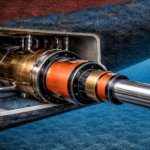
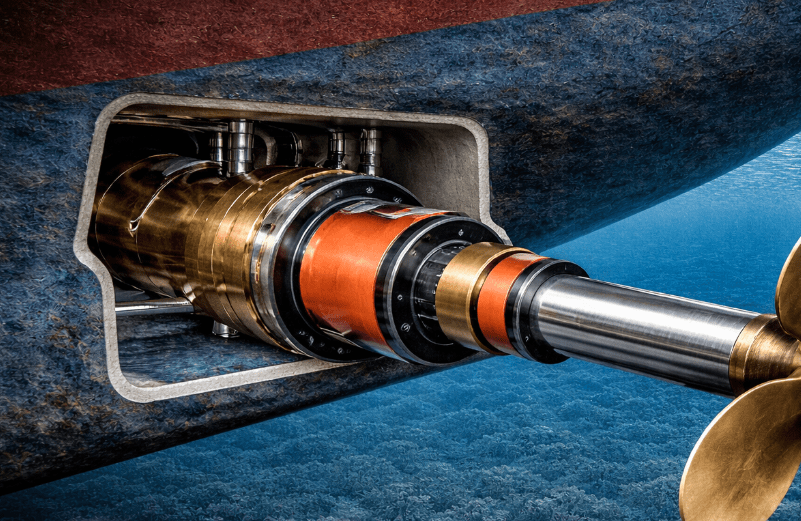
The focus is on water-lubricated propeller shaft bearings. These guide a ship’s drive shaft in the stern area and are lubricated with seawater instead of oil. This reduces environmental risks but does not make monitoring any easier.
“Today, bearing wear is still often inspected manually by divers,” says Bültemann. This is both complex and expensive. In addition, sensors are often difficult to retrofit. Measurements are taken outside the hull between the aft bearing and the propeller underwater—typically in very confined spaces.
Eddy-current sensors used so far work very precisely but require extremely small distances to the measured object. “Eddy-current sensors work particularly well and accurately when they have a sub-millimeter distance to the measurement object. However, when monitoring ship shafts, distances of one centimeter or more must be measurable.” The large coils required for this increase the size and power consumption of such devices.
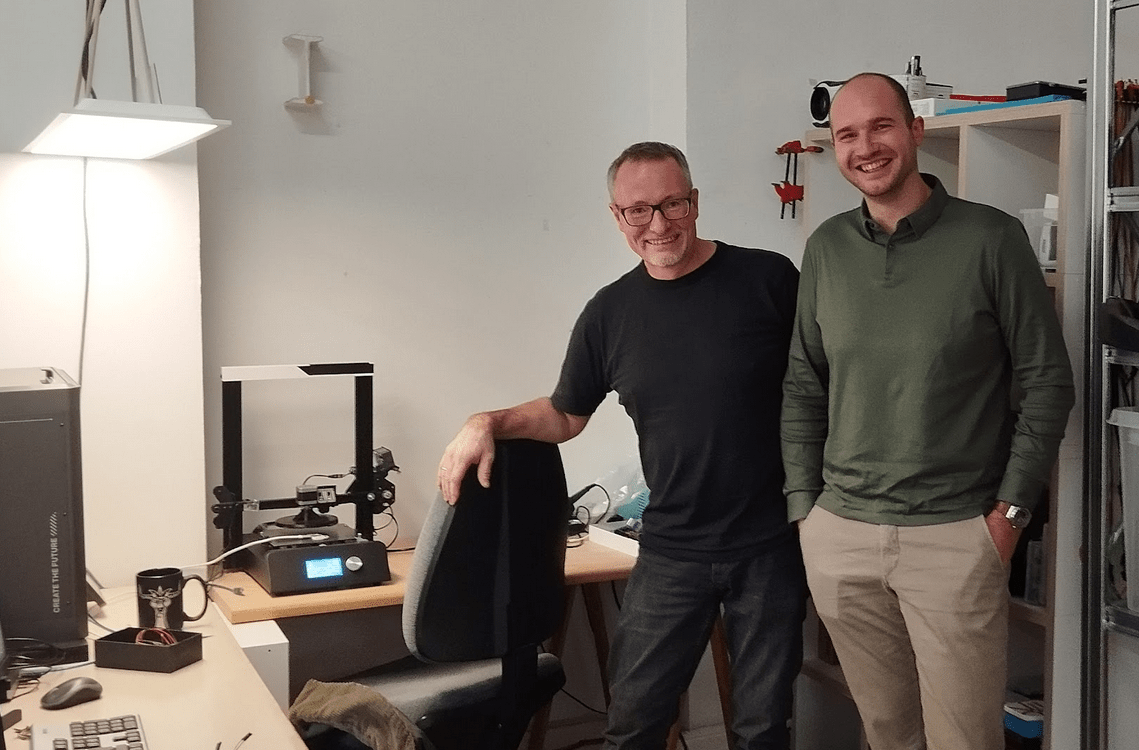
Christoph Bültemann (l.) with Prof. Dr. Sebastian Groß from Bonn-Rhein-Sieg University of Applied Sciences in his Cologne laboratory. On the table by the wall lies the prototype on a measurement setup similar to a 3D printer. Photo: Carsten Roepert
Digitized shaft position instead of eddy currents
This is where Bültemann’s project “ClearSense” comes in. “ClearSense does not measure eddy currents but is based on a different physical measurement principle with very low power consumption,” explains Bültemann. The method digitizes the shaft position into a pulse-width ratio, which is evaluated by a microcontroller unit contained in the sensor.
“The sensor is therefore very compact and can also be used on medium and smaller ships where space is extremely limited.” The goal is to continuously monitor bearing clearance and thus detect wear at an early stage.
The system is to be complemented by “Houdini,” a solution for wireless energy and data transmission through the ship’s hull. “Yes, it is an in-house development in an early stage with some promising initial results. Just like with ClearSense, I cannot disclose details at this point.”
Prototypes available, field tests planned
According to Bültemann, functional laboratory prototypes already exist. “We have a setup for precise sensor characterization and a compact demonstrator.” A simulator that more realistically represents large shaft diameters is currently under construction.
The transition to field testing is complex. Tests on real ships are expensive and require individual approval from the relevant classification society. A field-test partner has already been identified. In the current phase, the project is supported by the “Marine Technology Innovation Center” in Nantong.
At the same time, intellectual property protection is underway. “We have already begun IP protection. Initial patents have been filed.”
Funding in the Yangtze Delta
Public reports mention potential funding of up to four million US dollars under the Chinese program “National Innovation Center par Excellence” (NICE). Bültemann puts this into perspective: “We are currently in the project cultivation phase, which is already supported with a sufficient working budget.” The goal is to reduce technical, regulatory, market, and personnel risks and to prepare for a company formation. “After that, the actual financing negotiations will begin.”
Why China? “A location in one of the world’s largest shipping regions is very suitable for establishing a company in the field of marine maintenance, as it provides direct access to shipyards and fleet operators.” In addition, there is a funding program in the Yangtze Delta specifically designed to attract technology companies.
Germany will nevertheless remain important. “At the same time, Germany remains a central location for research and innovation.” Initial collaboration is already taking place with the academic environment. In the future, this could lead to topics for student research projects, Bültemann adds.
A niche topic with potential
Continuous monitoring of propeller shaft bearings is not yet a mass market. However, increasing environmental regulations, rising operating costs, and the push toward digitalization in shipping could drive demand.
Whether ClearSense can compete with established condition-monitoring providers will only become clear after successful field tests and certifications.
One thing is certain: Bültemann is transferring his experience in digital signal processing to a classic industrial problem. If the sensor proves reliable under real-world conditions, it could shift a largely analog maintenance field toward real-time monitoring.
User Review
( votes)
You may also like