Electricity from Humidity: What the Paper Wallpaper Really Delivers for IoT Sensors
 Dennis Knake
Posted On 5th October 2026
Dennis Knake
Posted On 5th October 2026
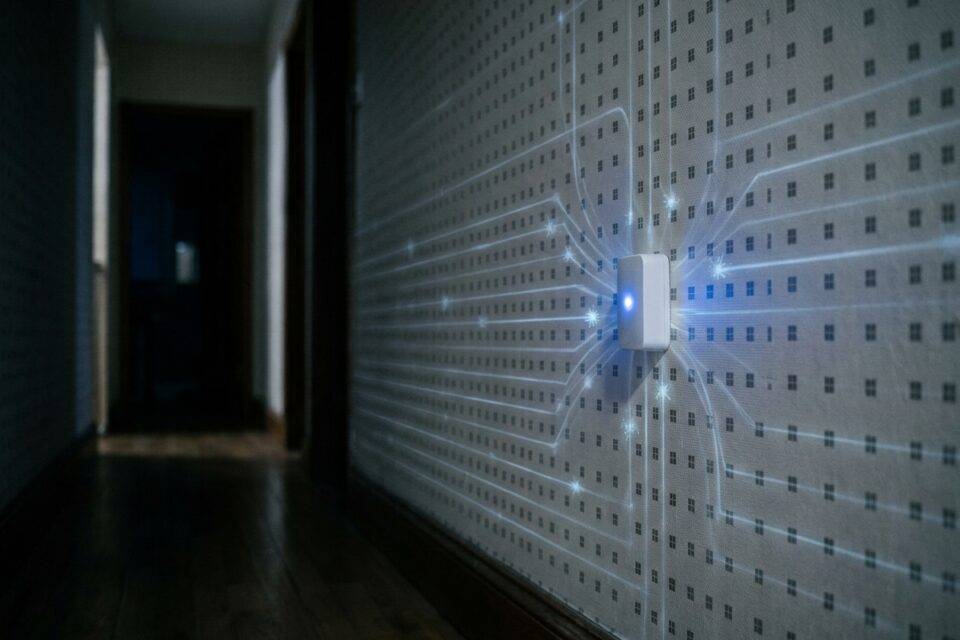
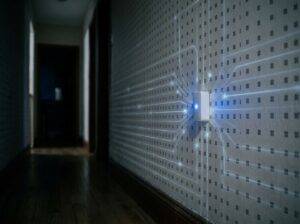
A paper wallpaper developed at Binghamton University draws enough electricity from room air to power a wireless keyboard in bursts. That will never be enough for household appliances. For frugal wireless sensors in places without light, it could suffice, provided the wallpaper survives everyday use.
- Researchers at Binghamton University have developed a paper wallpaper that generates electricity from indoor humidity, and a wall array of 1,596 cells powered a wireless keyboard at 38 percent relative humidity.
- Per unit area, the wallpaper delivers only a fraction of the output of indoor solar cells, but it works in the dark and around the clock.
- The energy could be enough for battery-free wireless sensors of the kind the standards body 3GPP is standardizing as Ambient IoT, but long-term tests on the wallpaper’s durability are still pending.
How does paper generate electricity from humidity?
Paper, glycerol, a polymer, wax and electrodes: these are the basic ingredients the team led by Seokheun Choi uses to build cells that turn room air into electricity. Choi is a professor of electrical and computer engineering at Binghamton University in New York State. In September, his group published its results in the journal Advanced Energy Materials.
Each cell is a moist-electric generator (MEG), a component that produces electrical voltage from water vapor. The material absorbs moisture. Ions dissociate and move. A concentration gradient forms, and this gradient builds up a voltage between the electrodes. Moisture generators are not new. According to Choi, however, previous designs targeted outdoor use, where sunlight and weather make the output fluctuate. Choi focuses on indoor spaces. There, according to the university’s press release, relative humidity stays steadily between 30 and 60 percent.
Anyone who breathes, cooks or showers adds more. The trick lies in how the cell is built. The cell only delivers power as long as the moisture flows in one direction. If it spreads evenly, the gradient disappears, and the voltage goes with it. The researchers therefore put three zones on a single piece of paper. At the edge, glycerol captures water vapor. Glycerol is hygroscopic, meaning it attracts water. Further in, the polymer polyvinylpyrrolidone (PVP) binds the water more strongly and draws it toward the center.
There, a waxed area holds back liquid water but lets vapor escape. The cell takes up water, passes it on and releases it again. A simple experiment shows that this cycle produces the current. When the researchers sealed off the glycerol edge, the voltage collapsed almost completely. When they covered the waxed center, a voltage built up at first and then gradually faded.
For the wall, the team needed a second trick. Nobody wants to see hundreds of wires in the living room. So the researchers used a laser to drill fine holes through the paper and filled them with conductive material. These through-connections, called vias in electronics, link the electrodes on the front to conductive traces on the back. For the overall design, Choi drew on his work on papertronics, electronic circuits built directly into paper.
What did the wallpaper achieve in the lab?
Each cell measures two by two centimeters. At 80 percent relative humidity, it delivered an open-circuit voltage of 0.34 volts. Two power figures are circulating, and the difference matters. Calculated over the electrode area, the cell reached about 2.2 microwatts per square centimeter. Calculated over the whole cell, it is only about 0.55 microwatts per square centimeter. The second figure is the one that counts for any comparison, because on a wall the entire cell takes up space.
The cells also worked in drier air. Between 20 and 80 percent humidity, they held their voltage for more than 90 minutes at each humidity setting, though at a lower level in dry air. Ten cells in series produced about 2.9 volts at 80 percent humidity. The cells can therefore be combined predictably. Two demonstrations show where the researchers are heading.
A wall array of 1,596 cells generated about 3.5 volts at around 38 percent humidity. It repeatedly charged a capacitor, which powered a wireless keyboard in bursts. A smaller array of 35 cells ran a commercial humidity sensor for about 15 minutes at around 30 percent humidity. Both ran without a battery.
Is that enough for real IoT sensors?
The headline about power-generating wallpaper raises false expectations. At 0.55 microwatts per square centimeter, one square meter of wallpaper delivers at best about 5.5 milliwatts, and that is at 80 percent humidity. The 1,596 cells of the test array together cover about 0.64 square meters, the area of a square roughly 80 centimeters on each side. On paper, they would reach about 3.5 milliwatts, but the experiment ran at only 38 percent humidity.
A five-watt LED bulb would need around 900 square meters of wallpaper in humid air, more than three tennis courts. For a wireless sensor, however, that is a lot. A frugal sensor board needs a source with more than 2.65 volts and an average of over 50 microwatts. It carries an environmental sensor and transmits via Bluetooth Low Energy, a wireless standard for devices with low power requirements. This comes from a study in Light: Science & Applications that powered such a board with indoor solar cells.
About 23 wallpaper cells deliver this power at 80 percent humidity, on just under 100 square centimeters. That is smaller than a postcard. Because a single cell delivers only 0.34 volts in open circuit, many of them have to be connected in series. At typical indoor humidity of 30 to 50 percent, considerably more area is needed. What matters is how the sensor works. Hardly any sensor needs to transmit constantly. It measures, sends a value and goes back to sleep. This principle is called duty cycling: the device is active only a fraction of the time. That suits a weak but steady energy source. The source charges a storage element, such as a capacitor, and the sensor draws short bursts of current from it. That is exactly how the keyboard demonstration worked.
The mobile industry is moving in the same direction. With Release 19, the standards body 3GPP defines Ambient IoT for the first time. The term covers devices without a battery or with only a small energy store that draw their power from their surroundings. According to 3GPP, the device class standardized in Release 19 gets by with a peak power of about one microwatt. Release 19 leaves open where the energy comes from. By our calculation, a single wallpaper cell in humid air exceeds this mark with just over two microwatts. For continuous Wi-Fi transmission or for displays, the wallpaper stands no chance.
How does the wallpaper compare with indoor solar cells?
The obvious competitor hangs from the ceiling: light. Indoor solar cells, meaning photovoltaics designed for artificial light, are already available as commercial products. For three commercial technologies, a roadmap in the Journal of Physics: Energy lists values between 4 and 90 microwatts per square centimeter. Dye-sensitized cells reach 4 to 35, organic cells 15 to 17, and gallium arsenide cells 70 to 90. The measurements, however, were taken under different lighting conditions.
Per unit area, solar cells therefore deliver roughly 7 to 160 times as much as the wallpaper. The comparison has a catch. According to the study in Light: Science & Applications, homes typically receive only 200 to 500 lux, offices 500 to 1,500 lux. At night it is dark. In a cupboard, a hallway, a basement or behind the sofa, a solar cell delivers little or nothing. Humidity is there around the clock. The wallpaper therefore does not replace indoor photovoltaics. It could complement it where no light reaches.
How far apart the approaches are is shown by a study from Tokyo and Michigan published two weeks later. The researchers build switchable coils into furniture that locally concentrate the magnetic field of a room-sized resonator. According to their paper in npj Wireless Technology, they delivered up to 500 milliwatts to a receiver 15 millimeters in diameter. The price: 9 watts of input power, an efficiency of about five percent and a room that is itself built as a resonator. The wallpaper sits at the other end of the scale. It delivers little energy but needs no transmitter and no converted room.
Can the wallpaper dehumidify room air?
The wallpaper does not absorb moisture only to generate electricity. It also buffers it. In a closed test chamber, 28 cells lowered relative humidity from about 75 to 50 percent in around four minutes. In very dry air, the effect reversed: pre-moistened wallpaper released water, and humidity rose from about 15 to 20 percent. In the wall experiment, room humidity fell from 38 to 32 percent within 15 minutes. Choi sees an opportunity for buildings that currently spend a lot of energy on dehumidification.
That has not been proven. The researchers themselves regard the wall experiment as only the material’s initial response. The data do not show how much moisture the wallpaper absorbs and releases over time in an occupied room.
What does the wallpaper still have to prove?
“It was not easy to integrate three different areas into one paper,” Choi says in the press release. His goal: everything should be printable, so the wallpaper can be mass-produced at a larger scale. The university names neither a product nor a timeline. Above all, long-term data are missing. Paper swells in humid air and shrinks as it dries. Whether this damages the graphite traces or the vias over months remains open. It is also unclear whether the glycerol migrates through the paper over time and blurs the separated zones.
Then the gradient that supplies the current would collapse. Even how exactly the current arises has not been settled. The authors suspect that protons carry most of it. Builders and building operators are likely to ask another question: does a paper wall that deliberately stores moisture encourage mold? That must be answered before anyone powers sensors from the wallpaper.
Conclusion
The wallpaper from Binghamton does not supply household power, and its developers do not promise any. Its value lies elsewhere. It shows that a weak but steady flow of energy can be collected over large areas, by day and by night. For battery-free sensors of the kind the mobile industry is preparing with Ambient IoT, that is the right order of magnitude. What the wallpaper needs now is not higher voltages but long-term data. Will it survive months of swelling and drying? Will the gradient remain stable, and will the wall stay free of mold? Walls that measure, buffer and supply a little electricity on the side: that would be worth more than any record voltage.
At 80 percent humidity, one cell of the Binghamton paper wallpaper delivers about 0.34 volts and, calculated over the entire cell area, about 0.55 microwatts per square centimeter. Scaled up, that is at best about 5.5 milliwatts per square meter. This is enough for frugal sensors, but not for household appliances.
In the lab, an array of 35 wallpaper cells ran a humidity sensor for about 15 minutes, and an array of 1,596 cells powered a wireless keyboard. This works because a capacitor collects the energy and releases it in short bursts. Long-term tests for continuous everyday operation are still missing.
A moist-electric generator absorbs water vapor from the air. The moisture sets ions in motion within the material, and the resulting concentration gradient produces an electrical voltage. For the current to flow continuously, the moisture must move in one direction, for example from an absorption zone to an evaporation zone.
Not per unit area: depending on technology and lighting, commercial indoor solar cells deliver roughly 7 to 160 times as much as a humidity-powered wallpaper. The wallpaper, however, works in the dark and around the clock. It is therefore better suited as a complement in places without light, such as cupboards, hallways or basements.
Ambient IoT refers to connected devices that work without a battery or with only a small energy store and draw their power from their surroundings, for example from radio waves, light or heat. The standards body 3GPP defines the technology in Release 19. The device class standardized there gets by with a peak power of about one microwatt.