
SGP.32 is gaining recognition across the IoT connectivity market. The harder problem is making it tangible enough for product teams, solution architects and customers to reason about – before procurement, rollout and the first production incident.
The Most Important Points
- Recognition is not readiness: product teams may know the SGP.32 name without being able to reason about what it actually changes in behavior, responsibility and operations.
- The next SGP.32 breakthrough will not come from another feature list or portal – it will come when someone builds a playground where the standard’s behavior becomes visible before procurement and rollout.
- The more critical the use case – connected vehicles, healthcare, industrial IoT – the more dangerous it is to sell flexibility as an abstract promise without giving teams a way to understand what they are buying and what they still need to govern.
One can repeat “SGP.32” often enough that the market recognizes it. That does not mean the market understands what to do with it. This is one of the adoption gaps we keep underestimating in IoT. Recognition is useful, but it is not the same as readiness.
A product team may have heard about SGP.32 – the GSMA standard for remote eSIM provisioning and lifecycle management in IoT devices. A solution architect may know that it has something to do with eSIM lifecycle management. A procurement team may even see it appear in vendor presentations. But that still does not mean they can reason about it. And if people cannot reason about a technology, they cannot confidently buy it, govern it or operate it.
Enterprise sales is normal. Enterprise mystery is not.
SGP.32 does not need to become a toy. It is an enterprise-grade standard for a complex ecosystem, and nobody should pretend otherwise. A sales process, a guided demo or a solution workshop is normal. Large-scale IoT connectivity is not something most companies should casually activate like a trial subscription. But enterprise sales should not mean enterprise mystery.
Before procurement, before rollout and certainly before the first production incident, product teams need a clearer way to understand what SGP.32 actually changes. Not only at the level of standards language, but at the level of behavior, responsibility and operational trade-offs. That is where I think the current conversation still has a gap.
Why recognition is not readiness
Rereading Afzal Mangal’s “IoT: The Hype No One Knows About” made me think again about a pattern that runs through much of the IoT industry. We often confuse awareness with adoption. People may hear about a technology. They may even agree that it matters. But if they cannot touch it, test it, break it and apply it to their own context, it remains abstract. SGP.32 risks falling into the same pattern.
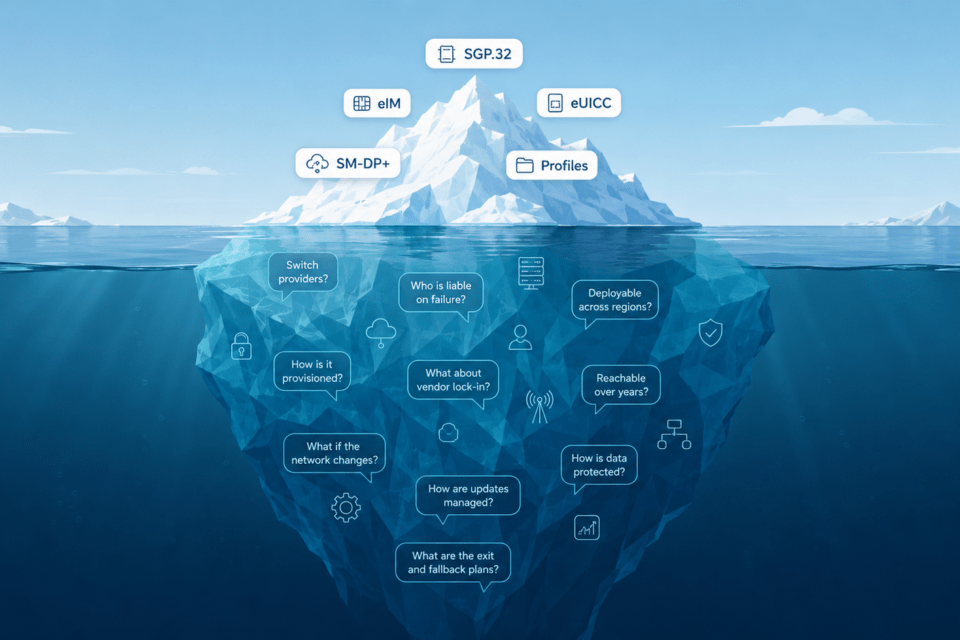
Right now, much of the SGP.32 conversation still lives in telecom language: eIM (the IoT Remote Manager that sits between device and network infrastructure), eUICC (the embedded SIM chip), IPAe/d (the IoT Profile Assistant on the device side), profiles, policies, SM-DP+ (the server infrastructure that prepares and delivers profiles). All correct. But still far away from how many product teams and solution architects actually learn.
The next breakthrough will come when someone makes SGP.32 easier to try, explain and reason about. In other words: SGP.32 needs a playground. Not a certification environment.
The problem is not that this terminology exists. It has to. Standards need precision. Architectures need defined components. Interfaces need names. The problem starts when the language of the standard becomes the only way to understand the value. A customer does not wake up wanting an eIM. A product team does not begin with IPAe/d. A fleet operator does not care about profile lifecycle management as an abstract concept. They care about questions like:
- Can I deploy one device variant across multiple regions?
- Can I change connectivity provider later without touching the device?
- Can I recover if the first connectivity choice does not perform as expected?
- Can I keep my devices reachable across long lifecycles?
- Can I understand who owns what when something fails?
- Can I use flexibility without creating operational chaos?
That is the translation layer SGP.32 still needs.
The next breakthrough will not come from another portal
The next SGP.32 breakthrough will not come from another feature list. It will not come from another portal screenshot. It will not come from another slide that says “remote profile management”, “carrier flexibility” or “future-proof IoT connectivity.” Those things matter, but they are not enough. The next breakthrough will come when someone makes SGP.32 easier to try, explain and reason about. In other words: SGP.32 needs a playground. Not a certification environment. Not a production-grade simulation. Not a vendor-controlled demo where everything works because the path is already prepared. A playground. A place where the behavior becomes visible before procurement, rollout or the first escalation.
Why software-defined vehicles are an interesting comparison
Software-defined vehicles – cars and commercial vehicles where functions are controlled by software rather than fixed hardware, enabling over-the-air updates and remote diagnostics – are an interesting comparison. Not because every SDV detail maps one-to-one to eSIM, but because the learning pattern is powerful. Even a small SDV playground with ECUs (Electronic Control Units, the embedded computers managing vehicle functions), CAN bus, a TCU, MQTT and cloud connectivity makes the architecture tangible.
Nobody confuses that with a production vehicle. But suddenly, vehicle-to-cloud is not a slide anymore. You can see state. You can break timing. You can test trust. You can understand why connectivity, backend reachability and lifecycle control matter. That kind of hands-on environment does something a presentation rarely achieves: it turns abstract architecture into something people can reason about. This matters because modern connected products are not built around one isolated component. They are systems of systems. The value sits in the interaction between device, connectivity, cloud, policy, lifecycle and operations. That is true in SDV. It is also true in SGP.32.
What an SGP.32 playground could show
If SGP.32 stays locked inside compliance documents, telecom terminology and vendor-controlled demos, it will remain understandable to specialists and abstract to everyone else. That may be fine in the early phase of a standard. It is not enough for broader adoption. A useful SGP.32 playground could show:
- Virtual device and eUICC behavior
- Sample eIM flows
- Mocked SM-DP+ responses
- Test profiles
- APN and routing scenarios
- Audit trails and failure states
- Simple policy recipes
The point would not be to turn customers into telecom experts. Exactly the opposite. The point would be to help product teams, solution architects and enterprise stakeholders understand what they are buying, what they are outsourcing and what they still need to govern. That distinction matters. Because SGP.32 is often discussed as if it only creates more freedom – freedom to change profiles, freedom to choose connectivity providers, freedom to manage devices over long lifecycles. But freedom without understanding is not yet control. It is only optionality. And optionality becomes valuable only when customers understand how to use it safely.
Why critical use cases make this even more urgent
This becomes especially relevant in high-stakes deployments. In connected vehicles, connectivity is no longer just “the SIM.” It touches OTA updates, diagnostics, emergency services, subscriptions, regional requirements, cybersecurity and service continuity. The same logic applies to healthcare, utilities, logistics and industrial IoT.
The more critical the use case, the more dangerous it is to sell flexibility as an abstract promise. In a non-critical scenario, unclear lifecycle behavior may create inconvenience. In a critical scenario, it can create operational risk. That is why SGP.32 needs to be understandable not only to standards experts, but also to the teams responsible for product decisions, customer promises and day-2 operations – the ongoing management after initial deployment. A product team should be able to understand what happens when a profile is downloaded, enabled, changed or removed.
There is a difference between “SGP.32 supported” and “SGP.32 understood.” Supported means the technical capability exists. Understood means the customer can reason about the implications
A solution architect should be able to reason about how this interacts with routing, policies, connectivity reachability and backend behavior. A customer success team should be able to explain the lifecycle without needing a standards expert in every conversation. If that is not possible, the issue is not the standard. It is the translation layer around it.
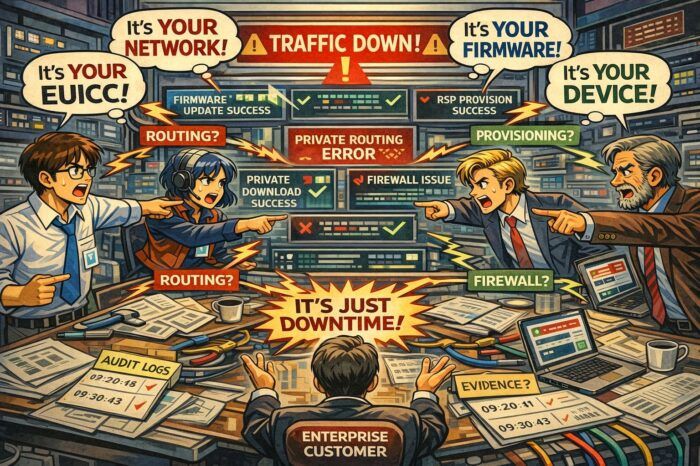
This also connects to a broader challenge I explored in an earlier piece on WeSpeakIoT: SGP.32 works in the lab, but breaks at the boundaries – the handovers between device, eUICC, RSP infrastructure, network and enterprise IT. Teams that have never had a way to experience those boundaries in a safe environment arrive at production underprepared. A playground would not solve every boundary problem. But it would reduce the number of teams encountering them for the first time in a live deployment.
From supported to understood
There is a difference between “SGP.32 supported” and “SGP.32 understood.” Supported means the technical capability exists. Understood means the customer can reason about the implications. Supported belongs in a feature matrix. Understood belongs in product strategy, procurement, operations and support.
That is where adoption happens. This is also where many IoT technologies struggle. They become technically possible long before they become easy to consume. They are correct, but not obvious. Powerful, but abstract. Available, but difficult to explain outside the expert circle. SGP.32 should avoid that trap. It should not become another technology that everyone recognizes at conferences but only a small group can translate into practical decisions.
The next SGP.32 breakthrough will not come from another feature list. It will come when someone makes the standard easier to try, explain and reason about. That is when SGP.32 becomes more than supported. It becomes understood. And understood is what customers actually buy. Recognized is not the same as understood. For SGP.32, that difference may decide how fast the market actually moves.

You may also like