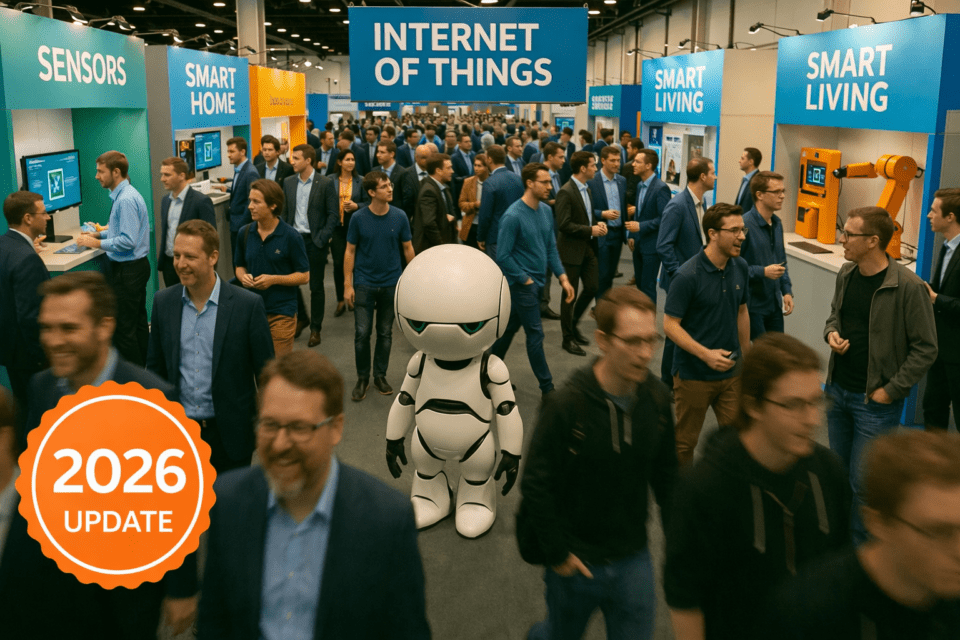
An overview of the most important IoT, AI, Embedded, and Maker events worldwide through the end of 2026.
A recent research article in the Journal of Engineering and Applied Science presents an improved optimization approach for routing in wireless sensor networks (WSN) within IoT scenarios. The Enhanced Archimedes Optimization Algorithm (EAOA) aims to save energy, reduce delays, and extend network lifetime. The authors report better results compared to conventional methods, but note that the findings are based solely on simulations. Practical tests on real hardware are planned but have not yet been carried out.
Criminals are exploiting unsecured cellular routers in industrial environments to send massive amounts of phishing SMS messages. According to a report by the IT magazine Ars Technica, based on analyses by the cybersecurity company Sekoia, devices from the Chinese manufacturer Milesight IoT Co., Ltd. are primarily affected.
California Governor Gavin Newsom signed the “Transparency in Frontier Artificial Intelligence Act” (SB 53) at the end of September 2025. The regulation requires developers of particularly powerful AI models to disclose safety measures and report incidents in the future. The goal is to monitor the risks of so-called “Frontier AI” systems — AI models whose computing power and capabilities go far beyond previous applications.
The security firm Bishop Fox found several security-relevant weaknesses in the YoLink Smart Hub (firmware v0382). In a blog post, security researcher Nick Cerne, who disassembled the device, read internal logs, obtained MQTT credentials and API information, shows how attackers could remotely control other smart-home devices.
Smart technologies once seemed like harmless conveniences, but their risks to freedom were underestimated. Data misuse by companies was tolerated as an economic issue, not seen as political repression. Bruce Schneier warns that in authoritarian contexts, state and corporate surveillance merge into powerful tools of control. What is acceptable in democracies today can quickly become a weapon against citizens tomorrow.
I have just reported about how Chinas Tech Giants challenge NVIDIAs AI Dominance by developing their own chips Now China has taken a decisive step in its race toward technological self-reliance: According to reports from the Financial Times (€), TechCrunch, and others, Beijing has instructed some of its largest technology companies to stop ordering and testing certain NVIDIA artificial intelligence (AI) chips, including the RTX Pro 6000D. This directive, communicated through the Cyberspace Administration of China (CAC), affects companies such as Alibaba and ByteDance and could signal a turning point in the global AI chip industry.
In the second week of September 2025, security researchers recorded one of the largest known Distributed Denial of Service (DDoS) attacks. The target was an undisclosed DDoS protection provider in Western Europe. The attack peaked at around 1.5 billion […]
On September 24–25, 2025, the international IoT community will gather at the IoT Tech Expo Europe in RAI Amsterdam. Around 8,000 professionals, more than 200 exhibitors, and about 250 speakers are expected. The trade fair offers a comprehensive overview of the Internet of Things (IoT) and adjacent technology fields – from artificial intelligence and big data to cloud security and digital transformation.
Nokia has opened a new R&D and manufacturing campus in Oulu, Finland, marketed as the “Home of Radio.” Covering 55,000 m², the site brings research, design, production, and testing of 5G and future 6G technologies under one roof.