Muse Charm: Meta’s AI Tamagotchi is meant to bypass Apple and Google. Users pay the price.
 Dennis Knake
Posted On 28th September 2026
Dennis Knake
Posted On 28th September 2026
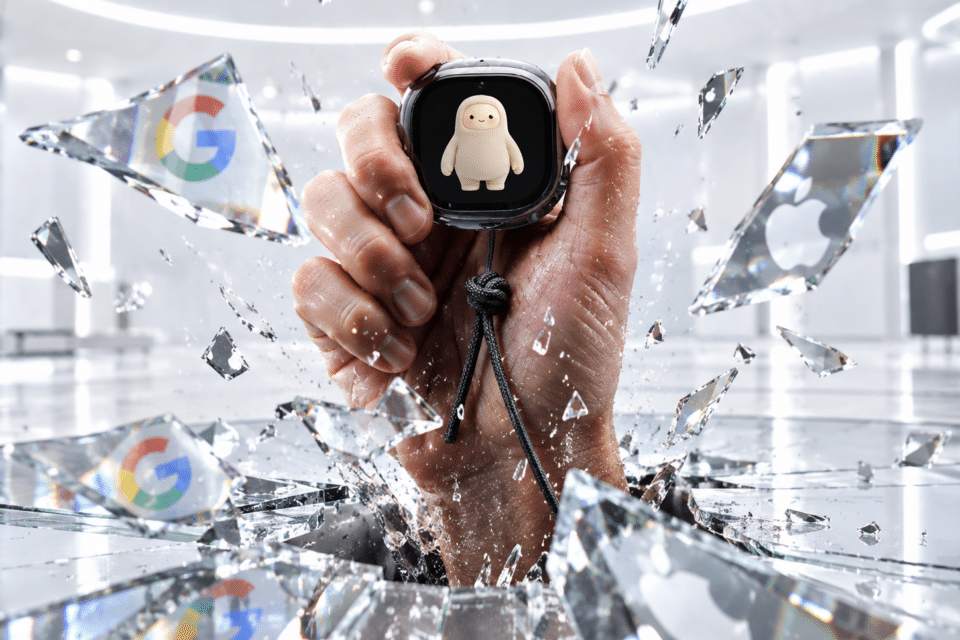
With the Muse Charm, Meta is selling a cute AI gadget that mainly solves a problem for Meta itself: the company wants to reach customers directly, bypassing Apple and Google. Users pay the price. They are asked to hand an agent their inboxes, accounts and payment methods, which Meta, by its own account, can access.
- Meta unveiled the Muse Charm at Connect 2026, a palm-sized pendant with a roughly 2-inch display, cameras, a 5G modem and a fingerprint sensor, due to go on sale in December.
- The Charm is a gateway to Meta’s AI agent Muse, which writes emails, shops and fills out forms, and it is meant to open a path to customers that Apple and Google do not control.
- Muse stores login credentials in a cloud machine run by Meta, and by Meta’s own account, the current architecture does not prevent the company from accessing that data when needed.
Keynotes build toward this moment. The presentation at Meta Connect 2026 seemed to be over when Mark Zuckerberg reached into his pocket one more time. Out came a palm-sized device with a small screen showing a fluffy creature. The Muse Charm: a “Tamagotchi” connected to Meta’s new AI agent. Meta had built only a handful of units so far, Zuckerberg admitted. He did not name a price. Meta’s chief technology officer Andrew Bosworth called the device an “exploration” in an interview with Bloomberg, the classic v0. The company wants to see how people use it.
In plain terms: customers test, Meta learns. Whoever buys in December is funding the field trial.
What can an “AI Tamagotchi” with power of attorney do?
The Charm itself does little. It is the keyhole to Muse, the AI agent Meta launched in the US on September 8. An AI agent does more than answer questions: it acts. Muse writes emails, books trips, fills out forms and negotiates on its user’s behalf. To do so, it runs on a virtual machine, a dedicated computer in Meta’s data center, with its own browser and the login credentials of every connected service.
The offer has struck a nerve. According to Sensor Tower, Muse passed more than 3.4 million downloads in just over two weeks. The Charm is meant to keep this agent within constant reach: finger on the sensor, speak, done. Through cameras on the front and back, Muse is supposed to see what is happening around the user. A built-in 5G modem makes the device independent of Wi-Fi.
Why is Zuckerberg in such a hurry?
According to Bloomberg, Meta originally planned to launch the Charm in 2027. Zuckerberg pushed the teams to unveil it in 2026 and sell it before Christmas. Customers did not ask for it. The rush has other reasons. The first is called Apple, the second Google. Meta has lived on other companies’ platforms for years. Anyone who opens Instagram does so on an iPhone or an Android device, under the rules of those platforms’ owners.
According to CNBC, the Charm is Zuckerberg’s latest attempt to break free from Apple in particular as a distribution channel. Meta has just learned how vulnerable an agent is on someone else’s turf: Amazon blocked Muse from its store because the agent does not identify itself while shopping. The third reason is money. Meta plans to take a small fee on transactions that run through Muse, Zuckerberg announced. Payments go through Stripe Link, Shop Pay and PayPal. Apple Pay and Google Pay do not appear in Meta’s announcements.
So Meta is not fighting the gatekeepers of the platform world. Meta wants to become a gatekeeper itself, one floor up, collecting a cut of every booking. A supposed race with OpenAI explains this only in part. According to 9to5Mac, OpenAI’s device with designer Jony Ive is not expected until next year. More pressure comes from investors and analysts who, after billions spent on AI talent and data centers, finally want to see products.
Who books a trip on a two-inch display?
The idea has a precedent, and it failed: with Alexa, Amazon did not aim to profit from the devices but to make ordering easier. Customers were supposed to shop by voice. They did not. According to The Information, only about two percent of Alexa owners had ordered by voice in 2018, and 90 percent of them never tried again. Amazon disputed the figures. The losses speak more clearly: according to The Wall Street Journal, the devices division lost about $25 billion between 2017 and 2021. A former senior employee told the paper: “We worried we’ve hired 10,000 people and we’ve built a smart timer.”
Customers used Alexa for weather, music and switching lights on and off. When shopping, they wanted to see what they were buying. The Charm will fail for the same reason. Who books a flight without a seat map and a price comparison in front of them? Who orders a sofa on a screen two inches across? For a quick reply to an email, that may be enough. For anything that costs money, users will reach for their smartphone again.
Meta knows this. Bosworth himself expects most people to use Muse through their phones and glasses, not the Charm. The device is not a tool. It is a billboard with a fluffy face. Early buyers also take a familiar risk. After HP took over what was left of Humane, its AI Pins stopped working. Meta itself pulled Limitless’s AI pendant from the market after acquiring the company in December 2025. A v0 with no place in the core strategy comes with no guarantee of survival.
Who holds the master key?
To be fair: Meta has put serious engineering into securing Muse. According to Meta’s security report, the agent only sees placeholders instead of real passwords. For purchases, it generates single-use card numbers, and every purchase needs approval. The decisive sentence appears further down in the same report. The current architecture does not prevent Meta from accessing the data when necessary to support, secure or operate the service.
Employee access is governed by internal policies. An encrypted version that locks Meta out is not due until later this year. Until then, the rule is simple: whoever gives Muse their inbox, calendar and payment details gives them to Meta. By default, conversations flow into AI training, stripped of key personal identifiers, and users have to flip a switch to opt out. And what Muse does on the web can, in Meta’s own words, influence which ads the user later sees on Instagram.
On top of that comes an unsolved fundamental problem. Meta itself calls prompt injection, meaning hidden commands in web pages or emails that redirect an agent, an open problem across the industry. Meta says Muse will make mistakes. Two weeks after launch, Meta had to close a flaw in the Mac app through which malware on the computer could grab the Muse account’s login token. A token is the digital ID card that keeps an account signed in.
Meta stresses that an attacker first had to run code on the Mac. The researcher who found the flaw counters that a trick luring users into pasting a command would be enough. The fingerprint sensor on the Charm changes none of this. It protects against someone who finds the device on a park bench, and even that is no guarantee: the Chaos Computer Club fooled Apple’s Touch ID back in 2013 with a fake finger made of latex or wood glue. The dangerous attacks happen in the cloud anyway, where no finger has a say.
Why does it have to be cute of all things?
Because cuteness disarms suspicion. The creature on the display can be dressed up, renamed and given its own voice. TechCrunch places the Charm in the trend toward bag charms that Gen Z has embraced since the Labubu craze. Muse itself is currently available only to adults. Meta has not earned the benefit of the doubt that the design demands. In 2019, the US Federal Trade Commission imposed a record $5 billion penalty on the company, then still called Facebook, for privacy violations.
In August 2026, Meta settled a lawsuit by US states that accused it of violating consumer protection and children’s privacy laws. Meta agreed to pay up to $18 billion. And the Charm carries cameras. After reports of covert filming, Meta’s camera glasses have long been mocked as “pervert glasses”. The problem is now moving onto the keychain.
Conclusion
European users are watching from the sidelines for now. Muse is not available in the EU. Hamburg shows how closely Europe is watching: in September, the city’s data protection authority concluded in a review of Meta’s camera glasses that recording bystanders usually has no legal basis.
The model behind the Charm will come anyway, with or without the pendant. The Muse Charm answers no question a customer has asked. It answers the question Meta has been asking for years: How do you get past Apple and Google? Meta’s answer is a cuddly toy with power of attorney.
The packaging is sweet. The price is the master key to all your data.
Muse Charm is a palm-sized AI device from Meta that Mark Zuckerberg unveiled at Meta Connect on September 23, 2026. It has a display of about 2 inches, a fingerprint sensor, cameras and its own 5G modem. The device provides direct access to Meta’s AI agent Muse without having to unlock a smartphone.
Meta plans to sell the Muse Charm from December 2026 but has not yet named any countries. The AI agent Muse, without which the device does not work, is not yet available in the EU. There is therefore no launch date for Europe.
Meta has not yet announced a price for the Muse Charm. According to Bloomberg, it is expected to be in the range of a smartwatch, and mobile network fees are also still open. The AI agent Muse itself has a free basic version, with subscriptions costing 20 or 100 US dollars per month.
Muse stores data and login credentials in a virtual machine in the cloud operated by Meta. According to Meta’s own security report, the current architecture does not prevent Meta from accessing it when necessary for support, security or operations. An encrypted version designed to lock Meta out has been announced for later in 2026.
Functionally, very little: all tasks are handled by the AI agent Muse, which also runs as a smartphone app. The Charm offers faster access via fingerprint and voice, plus its own cameras and its own 5G connection. It does not make phone calls and is set up through the Muse app on a smartphone.