Sovereign Doesn’t Necessarily Mean Local: Why Ukraine Deliberately Mirrors Government Data Abroad
 Dennis Knake
Posted On 24th November 2026
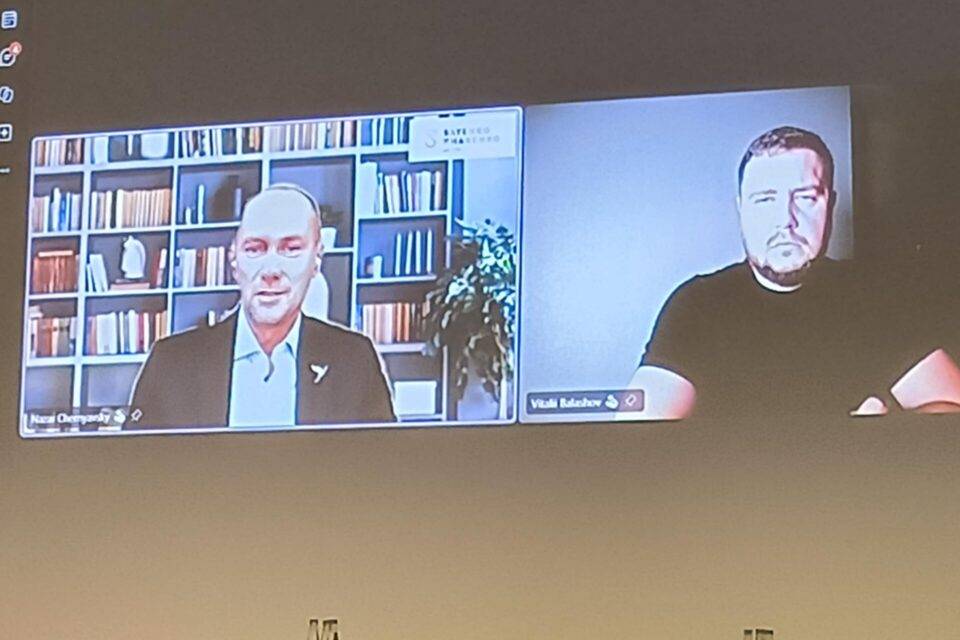
Ukraine measures digital sovereignty by control over its data, not by location alone. Because missiles and drones can reach almost any data center, government systems holding non-secret data need a copy on the other side of the border. At GvW Digital Day in Düsseldorf, Deputy Minister of Digital Transformation Vitaly Balashov explained how this works.
- According to Ukraine’s Deputy Minister of Digital Transformation Vitaly Balashov, every government IT system holding non-secret data needs a counterpart: if it runs abroad, an up-to-date disaster recovery copy must exist in Ukraine; if it runs only at home, one must exist abroad.
- With foreign cloud providers, Ukraine secures its control by technical means: it builds the environment in code to its own specifications, treats deviations from the security configuration as security incidents and keeps the encryption keys.
- As Balashov described it, Ukraine does not prescribe backup procedures but commits system owners to a recovery time measured in hours, leaving them free to choose between their own data center, the cloud and a hybrid setup.
November 19, Industrie-Club Düsseldorf. The law firm GvW Graf von Westphalen had invited guests to GvW Digital Day. The focus was on digital sovereignty, data security and resilient infrastructure. For almost the entire day, the talks revolved around one question: How much dependence on global cloud and AI providers can Europe afford without losing control?
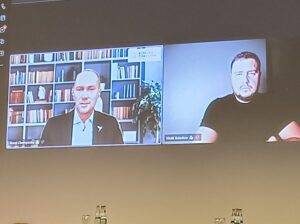
The closing session brought the perspective of a country that has to answer this question under fire. Joining by video from Ukraine were Vitaly Balashov, Deputy Minister of Digital Transformation for Cybersecurity and Cloud Technologies, and Nazar Chernyavsky, partner at the Kyiv law firm Sayenko Kharenko. Travel is difficult, and Ukrainian airspace is closed. Balashov explained why a common equation does not hold for his country: whoever keeps their data at home is sovereign.
Why is a single location a risk in wartime?
For Ukraine, sovereignty means controlling its own data, Balashov said. Keeping the data in the country would suit Ukraine. But the war shows that this does not always work: almost all of the country’s data centers are above ground, he said. Underground facilities that missiles and drones cannot reach make up only a small share and are mostly secret. He said he understands the European approach. But Ukraine cannot adopt it, because drones and missiles fly over the country.
How vulnerable centralized government IT is became clear in 2022. According to a Microsoft report, a week before the invasion the government was running entirely on servers located in government buildings. Early in the war, the report says, a Russian cruise missile attack targeted the government’s data center. Microsoft itself sells cloud services, so the report is not neutral.
Legally, Ukraine was barely prepared. Until 2022 there was practically no cloud legislation, Balashov said. Parliament passed the Law on Cloud Services on February 17, 2022, one week before the invasion. After the war began, the government and parliament allowed public authorities to use cloud servers abroad. According to Balashov, the ministry’s cloud rules apply only to the public sector and critical infrastructure. Private companies are free to choose.
Which three paths is Ukraine taking?
Against kinetic attacks, meaning attacks with weapons, Ukraine is pursuing three paths at once, Balashov said:
- Protected facilities: underground, hardened data centers, built with domestic companies and open to further partners. The project is expensive and takes a long time, he said.
- Distribution: Distributing the existing facilities is almost complete. A second generation of smaller, interconnected data centers is being planned with international donors.
- Abroad: moving data to places where no drones and missiles fly.
Even competitors help each other. Ukrainian cloud providers have agreed to serve as each other’s fallback site free of charge, Balashov said. If one fails, the competitor steps in and takes over disaster recovery. Telecommunications is also holding up, according to Balashov, precisely because the state cannot steer it centrally. Telecom regulation has historically been liberal, and the market grew freely. Hardly any authority can direct all network operators by decree, and that is exactly what makes the networks resilient. The owners cannot relocate their businesses and therefore look after stable networks themselves. At the front, Russia destroys facilities and fiber-optic lines every day. Procuring new fiber is one of the biggest tasks of the deputy minister in charge. Germany has already helped with that.
Why does every government system need a twin?
Balashov described the core of the approach as an obligation for all owners of government systems. If a system runs abroad, a disaster recovery instance with current data must exist in Ukraine. If it runs only in Ukraine, it needs such an instance abroad. That is somewhat more expensive, he said, but it limits the risk. The rule is publicly available in the legislation, he said, but he did not cite a specific provision.
He has already explained parts of it publicly. In October, Balashov told Interfax-Ukraine that if a system cannot be restored automatically, its owner must provide a guarantee. The system must be running again within a set number of hours, whether the disruption occurs in Ukraine or abroad. This is laid down in a cabinet resolution, he said. Copies of state registers may be held by authorized foreign providers or by Ukrainian companies with infrastructure abroad.
How does Kyiv keep control over data held by foreign providers?
In the end, you have to trust someone, Balashov conceded. He then described how Ukraine backs up that trust with technology. For government data at foreign providers, there is a dedicated environment that the security services and the ministry must approve. It is created through infrastructure as code: program code describes servers, networks and storage and builds them automatically. A new environment can be up in about 20 minutes. Ukrainian security operations centers, which monitor security events, oversee it. If storage suddenly becomes open or unexpected access appears, meaning the security configuration has drifted, this counts as a security incident. Ukraine’s incident response team then steps in.
Political risks, such as a change of government in a partner country, are at least partly mitigated by encryption. The keys remain exclusively in Ukrainian hands, and data abroad cannot be read by third parties. This takes a lot of work. There is no one-click procedure that encrypts and secures everything.
Distrust of US providers remains. Ukraine views direct access from the US side critically, Balashov said. The hyperscalers, the large cloud corporations, assure him every time that they do not use such access and that they operate transparently. Ukraine’s intelligence and security services do not share that assessment. The balance has to be found anew every day. In the Interfax interview, he also described the approval process that all providers go through regardless of origin: it checks security certificates as well as the location and ownership of the equipment, and the domestic security service SBU is involved.
Which data may leave Ukraine?
Data classification is the question he hears most often, Balashov said in response to a question from the audience. His ministry had examined models from Singapore, Germany, Italy and France and, after months of debate, decided against a new scheme. Reading the scattered existing regulations together is enough. They distinguish four levels: public, confidential, official (for official use only) and secret. According to Balashov:
- Public information may be stored anywhere.
- Confidential information, including government information, may go abroad under current law.
- Official information is subject to national encryption requirements that no hyperscaler supports. Exporting the cryptographic modules to trusted data centers abroad is theoretically conceivable but has not worked so far. There is therefore currently no practical way to move official data abroad.
- Secret information falls outside the cloud policy and must remain in Ukraine.
Public and confidential data account for the bulk, which is enough for now. There is far less official data, and the military takes care of it.
The questioner also wanted to know whether European politicians listen to Balashov or lean toward local sovereignty. Over a poor audio connection, Balashov did not address that part. An answer can nonetheless be sketched.
Where does this diverge from the EU sovereignty framework?
For its own cloud procurement, the European Commission has been assessing providers since October 2025 with a Cloud Sovereignty Framework. It comprises eight sovereignty objectives. Its criteria include keeping storage and processing strictly within European jurisdictions, without falling back on third countries. Another objective asks how exposed a provider is to non-European law, such as the US CLOUD Act. This law can give US authorities access to data held by US providers, even outside the United States. In April 2026, the Commission awarded a €180 million contract to four providers based on the framework.
Ukraine measures differently. For Ukraine, a fallback site outside the country is not a weakness but, for many systems, an obligation. Still, the contrast is not clear-cut. The EU framework limits data to European jurisdictions, not national ones. In 2022, Ukrainian government data moved to data centers across Europe, according to Microsoft. And the EU framework also asks whether a service keeps running if a provider withdraws its support.
On one point, both agree. The EU framework counts it as a mark of sovereignty when only the customer controls cryptographic access to its data. That is exactly how Balashov describes Ukrainian practice.
As I read it, the two plan for different threats. The EU framework is mainly meant to protect against foreign law and foreign control. Ukraine additionally plans for the physical loss of a site.
Why does Ukraine regulate outcomes rather than procedures?
In March 2025, Ukraine reorganized the cybersecurity of government systems. Law No. 4336-IX replaced an old, complicated compliance procedure with security profiles modeled on NIST SP 800-53, Balashov said. NIST SP 800-53 is the catalog of security controls published by the US National Institute of Standards and Technology. The law did away with many opaque and corruption-prone procedures, he said.
By April 2026, according to the government, more than 100 systems had gone through authorization under the new rules. Baseline profiles exist for confidential, official, secret and top-secret information.
Balashov goes further. From a draft regulation on how systems keep running in an emergency, he said, he struck entire passages that prescribed how and how many backups should be made. He does not care about that. What remained is a commitment from the system owner: within how many hours the function will be restored if the main data center is destroyed. Experts call this the recovery time objective, the longest tolerable outage. Whether a system runs in its own data center, in the cloud or in a hybrid setup should be decided by owners and architects, not politicians.
The same principle shapes the cloud strategy. The ministry has drafted a concept for developing cloud services from 2026 to 2031. According to Interfax, a further concept paper focuses on a hybrid multicloud that combines several cloud providers with in-house data centers. In the discussion, Balashov said the concept written by his team opens with this principle. Relying solely on domestic providers is too risky, he said, and so is relying solely on hyperscalers. In mid-November he was still hoping for cabinet approval.
Ukraine calls the approach Cloud Smart. Experts in Ukraine had often understood the American Cloud First as meaning everything must go to the cloud at any price, Balashov said. The US federal government has also adjusted course: from 2010 it required agencies to move IT services to the cloud where feasible, and in 2019 it revised the strategy under the name Cloud Smart. Ukraine has thus arrived at the same term as Washington.
What can operators of IoT and OT platforms take from this?
The following points are my assessment, not statements by Balashov. Anyone running IoT device fleets or OT systems, meaning control technology in industry and utilities, via cloud backends faces similar questions, just without missiles.
- Recovery time instead of a backup checklist: Anyone who commits to bringing a service back online within a fixed number of hours needs an architecture that can deliver. A list of backup intervals does not force that.
- A counterpart at a second provider: A second region with the same provider helps if a data center fails, but not if the provider fails. The Ukrainian logic argues for a counterpart at a different provider or in your own data center.
- Keys stay with the operator: Managing your own keys makes the storage location less critical.
- Drift as an incident: If you describe infrastructure as code, you can detect every deviation automatically and treat it like an attack.
Balashov spoke of safe, not just secure. What he meant: systems should keep running in an emergency, not just be protected.
Conclusion: Does the model also work in peacetime?
Asked by the audience why Ukraine is moving so fast, Balashov gave a surprising answer: in his view, his ministry works slowly. For a small legislative amendment, he was initially told it would take a month; he pushed that down to three weeks. The new minister, Oksana Ferchuk, considers even that too slow, he said. The driving force is the desire to end the war.
He then added an interesting thought: slowness is not only bad, because those who take their time work more thoroughly. Chernyavsky closed with an appeal: good rules only emerge when technical experts and lawyers develop them together.
How durable the model is remains not entirely settled. Originally, register copies could be stored abroad only for the duration of martial law plus six months. Since 2025, a government resolution has allowed data to remain in foreign clouds even after the war ends. However, the rules still rest largely on temporary martial-law provisions. A draft law is meant to make them permanent.
My takeaway for Europe: if you measure sovereignty only by location, you plan for legal risks, but not for losing a site.
Digital sovereignty in cloud services describes the ability to decide independently over one’s own data and IT systems. For its own cloud procurement, the European Commission assesses it against eight objectives, including legal jurisdiction, data location, supply chain and control over encryption. Ukraine puts control over the data at the center, not location alone.
Ukraine spreads its data across protected underground data centers, many smaller data centers within the country and cloud providers abroad. According to Deputy Minister of Digital Transformation Vitaly Balashov, every government system holding non-secret data needs a disaster recovery copy on the other side of the border. With foreign providers, Ukrainian authorities keep the encryption keys.
It depends on the threat. Localization protects against access by foreign legal systems but leaves data exposed to physical attacks or disasters at the site. Ukraine therefore combines both: copies at home and abroad, secured with its own keys.
Cloud First requires new IT systems to be considered for the cloud first. Cloud Smart leaves open whether a system runs in the cloud, in an in-house data center or in a hybrid setup. The US federal government revised its strategy as Cloud Smart in 2019, and Ukraine uses the term for its government cloud policy.
According to Ukraine’s Ministry of Digital Transformation, public and confidential information may be stored abroad. Official information is subject to national encryption requirements that major international cloud providers do not support, so there is currently no practical way to move it abroad. Secret information must remain in Ukraine.