
In 20+ years working around the news media as a communications agent, I’ve created – literally – thousands of stories across hundreds of media outlets. This spans 35+ industries. And without a doubt, the most frustratingly idiosyncratic of these is IoT.
At approximately $1 trillion, the IoT industry is well established with an incredibly bright future. It’s also among the least respected by political officials, financial markets, tech leaders and the news media. In fact, the number of times IoT garners a brief mention in top-tier global news outlets is in the single digits per month, with most references as mere asides within broader stories.
At a time when public trust in these longstanding institutions is at its nadir, the lack of interest may not matter too much for IoT executives content to see steady flows of VC dollars and revenue. But for anyone with experience outside IoT, this disconnect portends future problems.
In interactions over the years with multiple clients and dozens of companies in IoT hardware, software and connectivity, there’s been a somewhat comical desperation in executives trying hard to pump IoT as this immensely innovative corner of tech. They point to new concepts like the “internet of eyes” as another exciting step in IoT.
Blah, Blah, Blah.
The reality is stark: IoT is a commodity within the telecommunications sector. There are no founders who walk into a meeting and ask about IoT. There are no banks or investors who see IoT companies capable of going public and evolving into behemoths like Google or Microsoft.
Everyone in business and beyond just assumes everything is connected everywhere nowadays. The last two words of IoT are irrelevant. The internet is for collecting and delivering data and IoT is just the part that isn’t about smartphones.
There are no founders who walk into a meeting and ask about IoT. Everyone in business and beyond just assumes everything is connected everywhere nowadays.
Now that everyone is properly pissed off, let’s take a step back, and agree that IoT is a criminally underrated part of the tech. There’s no denying what the industry (soon to be “formerly known as IoT”) can do for the world, for governments, for societies, and for Wall Street. Innovation in IoT can reduce prices, make data collection more efficient, and offer new capabilities that unlock worlds of possibilities for bettering humanity.
But the end user doesn’t see any fundamental change in the commodity. They just see better data management around the globe. Taking two examples from recent We Speak IoT coverage, there’s the company building sensors for ship propellers and the company locking down shipping container tracking. The innovation derives from domain knowledge in the IoT industry, but it’s still about maximizing a commodity’s usage, not becoming a strategic difference maker.
It may be seen like a distinction without a difference, but for executives outside IoT, they view these as tactical efforts. A crude analogy: when a company opens a new facility and the movers use their Tetris skills to pack more into trucks and reduce the use of gas, it’s viewed as maximizing a commodity.
That does not at all negate the value of what IoT or shipping or electricity provide, and everyone in the IoT ecosystem can get rich just like everyone in the smartphone ecosystem.
The value of data from connected products is going to skyrocket in the years to come, and that’s why a rebrand for IoT is more urgent than ever. The much-derided term won’t make a comeback. It won’t get more mentions in the Associated Press, Agence France-Presse, the Asahi Shimbun, Wall Street Journal or CNBC.
This ties directly into the topic du jour of the day: AI. We all know AI is taking over the world. Every CEO in every industry is tossing the word into their earnings calls, packing the keyword into their prepared remarks in a desperate and pathetic attempt to seem like they’re on the cutting edge. And this week’s Allbirds rebrand from shoes to “AI compute architecture” is the cherry on top of the inane attempt to bring in some of those AI dollars from investors.
There is sure to be more Allbirds-like idiocy in the weeks and months to come. But it’s this unique brand of idiocy that validates why IoT must rebrand itself with AI. There is no industry with a more powerful, relevant and unironic claim to impacting AI than IoT. The trillions of sensors, cameras, meters and various devices that can be manufactured, deployed and connected nearly anywhere in the world are the force multiplier for AI. These devices are where AI truly meets the tactile world. IoT will help deliver on the promise of AI that technocrats have used to take over the stock market in the last 36 months.
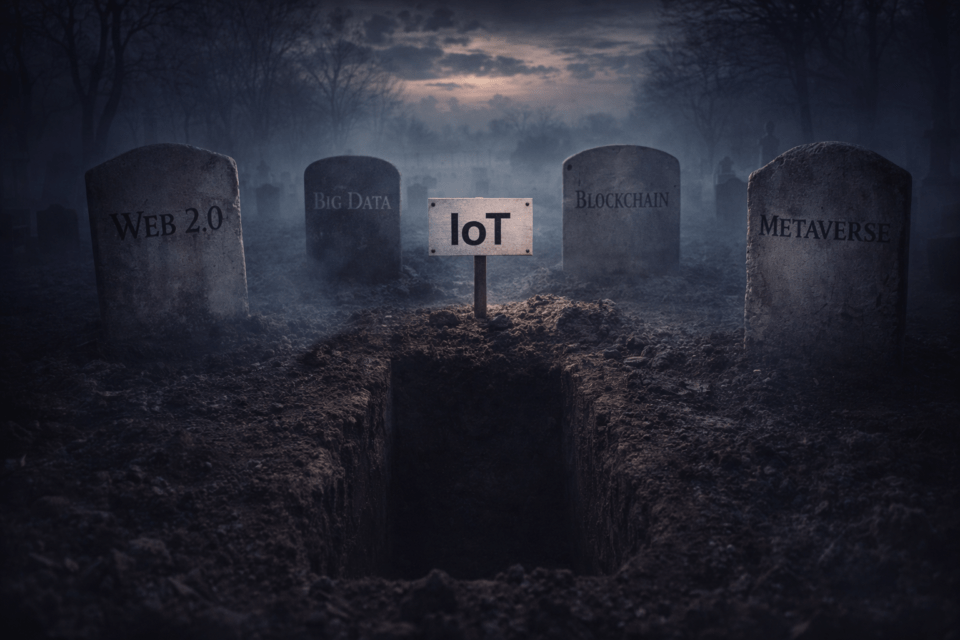
Frankly, it should have been a tipoff to IoT CEOs that the branding is dying two years ago when Enterprise IoT Insights — one of the few IoT-focused news sources — and the exceptional work of its editor James Blackman were folded into RCR Wireless. IoT conference have also been on the decline.
Regardless, it’s past time to make the move and cut ties with the old terminology. Obviously, every IoT CEO has already been hard at work pimping their use of AI. But everyone outside the industry sees right through it.
IoT will remain the most boring and disrespected trillion-dollar industry in the world.
The big problem is that they focus on what AI can do for IoT more than they focus on what IoT can do for AI. Too many companies are insistent on promoting advertorials on what IoT is doing for a city, company or industry. As if anyone in the real world is going to be amazed by the fact that the internet has the power to make things happen.
Instead of being a boring AF buzzword that’s been flailing since Facebook was a service for college students, IoT needs to fully embrace its role as a side player in AI and rebrand to something like EAI (Extending AI). That’s not necessarily the term to go with – every rebrand must be carefully conducted with a basis in research and data-driven insights. There are no shortcuts in evaluating demographics and psychographics, primary interviews across key audiences and market testing.
Of course, just getting to the point of attempting to redefine IoT the industry is an incredibly challenging undertaking with so many companies in the sector needing to agree on something. That’s not to mention the weak and ineffective IoT industry associations that are unlikely to help build a coalition.
Regardless of a proper industry change, every IoT company would be wise to start now on rebranding around what IoT can do for AI instead of the other way around.
Until then, IoT will remain the most boring and disrespected trillion-dollar industry in the world.


You may also like